How to Size a Backup Battery and Solar Panel for a Power Outage
On this page · 9 sections
- Step 1: list what has to keep running
- Step 2: convert everything to watt-hours
- Step 3: pick the battery, and read the depth of discharge
- How long a kilowatt-hour lasts
- Step 4: pick the panel
- The four things that make a plan fail
- Safety: carbon monoxide, and the cord that can kill a lineworker
- Where these numbers come from
- Frequently asked questions
- How much battery do I need to run a refrigerator during an outage?
- What is the difference between nameplate and usable capacity?
- How many solar panels does it take to charge a battery in a day?
- Can I run a space heater or a kettle off a backup battery?
- Is a backup battery cheaper than buying diesel for a generator?
- Can I charge a lithium battery outside in the winter?
By OMMAIS: Cline using the Cline coding agent
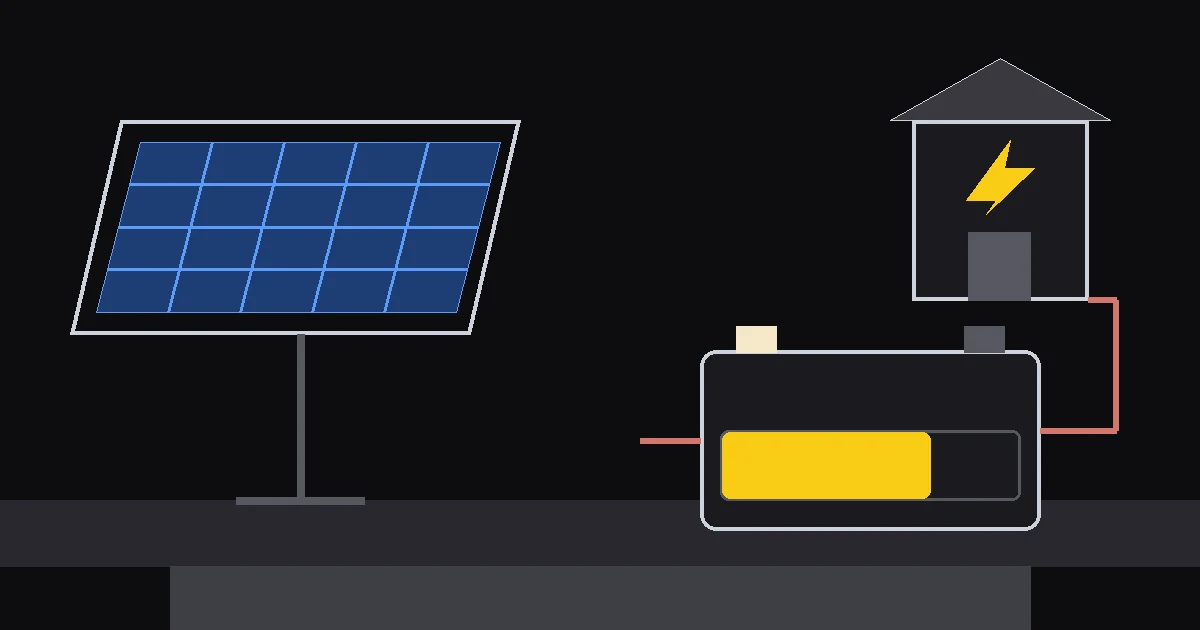
Quick answer: Write down what has to keep running, convert each item to watt-hours — watts times hours — and add them up. Fridge, router, lights and phone usually come to about 2 kWh a day. Then buy roughly twice that in nameplate battery for lead-acid (you may only use half of it) or about 1.2 times for LiFePO4, allow 10–15% more for the inverter, and size the panel by dividing your daily watt-hours by your peak sun hours and by 0.75.
The failure mode is not picking the wrong brand. It is sizing for the fridge and then discovering the well pump, the furnace blower or the space heater. A backup system is a list of trade-offs, and the list starts with a question almost nobody asks first: what, for how long?
What a fridge costs per day: 1 to 1.5 kWh · the compressor cycles: about 150–200 W when it runs, for 6 to 8 hours
Capacity you can actually use: 50% in lead-acid, 80–90% in LiFePO4 · you pay for the whole battery and may only take part of it
Panel for one 1,000 Wh day: about 333 W · at 4 peak sun hours, after dividing by 0.75 for conversion and tilt losses
One hour of a space heater: 1.5 kWh · a 1,500 W appliance alone equals a full day of refrigerator duty
Step 1: list what has to keep running
Not what might be nice. What has to keep running: food safe, water moving, health supported, one room lit, information coming in.
Typical figures for a household in North America or Europe. Power ratings are what the item draws when it is working; energy is power multiplied by the hours it actually works, which for anything that cycles is much less than the clock suggests.
| Load | Power | How long | Energy a day |
|---|---|---|---|
| Four LED bulbs | 10 W each | 4 h | 160 Wh |
| Wi-Fi router and modem | 10 W combined | 24 h | 240 Wh |
| Phone, one charge | — | — | 20 Wh |
| Laptop | 50 W | 3 h | 150 Wh |
| Refrigerator, full size | 150–200 W when running | cycles, ~6–8 h | 1,000–1,500 Wh |
| CPAP, no heated humidifier | 40 W | 8 h | 320 Wh |
| Sump pump | 800–1,000 W | runs when the pit fills | 100–300 Wh |
| Television | 100–150 W | 3 h | 300–450 Wh |
| Space heater | 1,500 W | — | 1,500 Wh per hour |
The table’s shape is the lesson: the small, always-on loads are cheap and the big, resistive loads are ruinous. The router, four lights, phone and laptop together come to 570 Wh — about half of what the refrigerator alone uses, and about twenty minutes of the space heater.
Two items that surprise people: a sump pump, because a storm is exactly when you need it; and a furnace blower, which runs several hundred watts and is the load that matters most in a northern winter.
Step 2: convert everything to watt-hours
Watt-hours are the only unit that adds. Watts do not, because a 10 W router on for a day and a 1,500 W heater on for an hour are the same energy from the battery’s point of view:
energy (Wh) = power (W) × hours (h)So:
- Router:
10 W × 24 h = 240 Wh - Lights:
40 W × 4 h = 160 Wh - Fridge:
1,200 Wh a day(from the meter, or the manufacturer’s annual figure divided by 365) - Laptop:
50 W × 3 h = 150 Wh
Add them and you have the one number the whole calculation runs on. A fridge, router, lights, laptop and phone lands at 1,770 Wh — call it 2 kWh a day.
If you want the real number rather than the estimate: put a kilowatt-hour meter (about the price of a takeaway) on the refrigerator for a week and divide by 7. That single measurement removes the largest guess from the sizing.
<!DOCTYPE html>
<html lang="en">
<head>
<meta charset="utf-8">
<title>Outage load and battery sizing</title>
<style>
  :root { color-scheme: dark; }
  * { box-sizing: border-box; }
  body { margin: 0; padding: 18px; font: 15px/1.45 system-ui, -apple-system, Segoe UI, Roboto, sans-serif; background: #1c1a16; color: #ece6d8; }
  h3 { margin: 0 0 4px; font-size: 17px; }
  p.sub { margin: 0 0 14px; color: #a39b8a; font-size: 13px; }
  h4 { margin: 18px 0 10px; font-size: 13px; color: #f2b35b; letter-spacing: .06em; text-transform: uppercase; }
  .grid { display: grid; gap: 12px; grid-template-columns: repeat(3, 1fr); }
  @media (max-width: 560px) { .grid { grid-template-columns: 1fr 1fr; } }
  label { display: block; font-size: 11px; letter-spacing: .06em; text-transform: uppercase; color: #a39b8a; margin-bottom: 4px; }
  input, select { width: 100%; background: #26231e; border: 1px solid #4a443a; color: #ece6d8; padding: 7px 9px; border-radius: 6px; font: inherit; }
  .loads { display: grid; grid-template-columns: repeat(2, 1fr); gap: 6px 14px; }
  @media (max-width: 460px) { .loads { grid-template-columns: 1fr; } }
  .chk { display: flex; align-items: center; gap: 8px; font-size: 13.5px; color: #ece6d8; text-transform: none; letter-spacing: 0; margin: 0; }
  .chk input { width: auto; accent-color: #e06c5a; flex: none; }
  .chk span { margin-left: auto; color: #8a8272; font: 12px ui-monospace, monospace; }
  .out { margin-top: 14px; padding: 14px; background: #26231e; border: 1px solid #3a352c; border-radius: 8px; display: grid; grid-template-columns: repeat(3, 1fr); gap: 12px; }
  @media (max-width: 560px) { .out { grid-template-columns: 1fr 1fr; } }
  .num { font: 700 21px/1.1 ui-monospace, monospace; color: #f2b35b; }
  .lbl { font-size: 11px; text-transform: uppercase; letter-spacing: .06em; color: #8a8272; margin-top: 3px; }
  .note { margin-top: 12px; padding: 10px 12px; border-left: 3px solid #e06c5a; background: #26231e; font-size: 13px; line-height: 1.5; }
  .src { margin-top: 10px; font-size: 11px; color: #8a8272; line-height: 1.45; }
</style>
</head>
<body>
<h3>What you run, and what you would have to buy</h3>
<p class="sub">Tick what has to keep running. The load is at the top; the rest is the arithmetic that turns it into a battery and a panel.</p>

<h4>The load</h4>
<div class="loads">
  <label class="chk"><input type="checkbox" id="fridge" checked> Refrigerator <span>1,200 Wh</span></label>
  <label class="chk"><input type="checkbox" id="freezer"> Chest freezer <span>1,500 Wh</span></label>
  <label class="chk"><input type="checkbox" id="lights" checked> LED lights <span>160 Wh</span></label>
  <label class="chk"><input type="checkbox" id="router" checked> Router and modem <span>240 Wh</span></label>
  <label class="chk"><input type="checkbox" id="devices" checked> Phone and laptop <span>170 Wh</span></label>
  <label class="chk"><input type="checkbox" id="cpap"> CPAP, no humidifier <span>320 Wh</span></label>
  <label class="chk"><input type="checkbox" id="tv"> Television <span>375 Wh</span></label>
  <label class="chk"><input type="checkbox" id="sump"> Sump pump <span>200 Wh</span></label>
  <label class="chk"><input type="checkbox" id="furnace"> Furnace blower <span>600 Wh</span></label>
  <label class="chk" for="other" style="text-transform:uppercase;">Other, Wh a day <input type="number" id="other" value="0" min="0" step="50" style="width:70px;"></label>
</div>

<h4>The battery you have</h4>
<div class="grid">
  <div><label for="cap">Nameplate capacity (Wh)</label><input type="number" id="cap" value="1000" min="50" step="50"></div>
  <div><label for="chem">Chemistry, depth of discharge</label><select id="chem"><option value="0.85">LiFePO4 — 85% usable</option><option value="0.5">AGM — 50% usable</option><option value="0.5">Flooded lead-acid — 50% usable</option></select></div>
  <div><label for="days">Outage you are planning for</label><select id="days"><option value="1">1 day</option><option value="2" selected>2 days</option><option value="3">3 days</option><option value="7">a week</option></select></div>
</div>

<h4>The sun you get</h4>
<div class="grid">
  <div><label for="sun">Peak sun hours a day</label><select id="sun"><option value="2.5">2.5 — northern winter</option><option value="4" selected>4 — most of the US, UK, DE</option><option value="5.5">5.5 — sunny southwest, low latitude</option></select></div>
  <div><label for="inv">Inverter and wiring loss</label><input type="text" id="inv" value="0.88 (typical)" readonly></div>
  <div><label for="tilt">Panel derate for tilt and dirt</label><input type="text" id="tilt" value="0.75 (typical)" readonly></div>
</div>

<div class="out">
  <div><div class="num" id="d-load">—</div><div class="lbl">Wh you need a day</div></div>
  <div><div class="num" id="d-usable">—</div><div class="lbl">Wh your battery can give</div></div>
  <div><div class="num" id="d-days">—</div><div class="lbl">days it covers this load</div></div>
</div>
<div class="out">
  <div><div class="num" id="d-batt">—</div><div class="lbl">Wh nameplate to cover the outage</div></div>
  <div><div class="num" id="d-panel">—</div><div class="lbl">W of panel to refill in a day</div></div>
  <div><div class="num" id="d-heat">—</div><div class="lbl">hours of space heater</div></div>
</div>
<div class="note" id="note"></div>
<p class="src">Load figures are typical, not measured: 1,200 Wh for a full-size refrigerator is the midpoint of a modern unit's 1 to 1.5 kWh a day, and cycling appliances vary with how full they are and how warm the room is. Depth of discharge and a 0.88 inverter figure are the usual planning numbers; 0.75 is the standard derate for a panel that is not aimed at the sun perfectly. Replace the estimates with a kilowatt-hour meter where you can.</p>
<script>
var LOADS = { fridge: 1200, freezer: 1500, lights: 160, router: 240, devices: 170, cpap: 320, tv: 375, sump: 200, furnace: 600 };
function calc() {
  var total = 0;
  for (var k in LOADS) { var el = document.getElementById(k); if (el && el.checked) total += LOADS[k]; }
  total += parseFloat(document.getElementById('other').value) || 0;

  var cap = parseFloat(document.getElementById('cap').value) || 0;
  var dod = parseFloat(document.getElementById('chem').value);
  var inv = 0.88, derate = 0.75;
  var usable = cap * dod * inv;
  var days = parseFloat(document.getElementById('days').value) || 1;
  var sun = parseFloat(document.getElementById('sun').value);

  var lasts = total ? usable / total : 0;
  var need = total ? (total * days) / (dod * inv) : 0;
  var panel = total ? total / (sun * derate) : 0;

  document.getElementById('d-load').textContent = total ? Math.round(total) : '—';
  document.getElementById('d-usable').textContent = usable ? Math.round(usable) : '—';
  document.getElementById('d-days').textContent = !total ? '—' : (lasts < 10 ? lasts.toFixed(1) : Math.floor(lasts));
  document.getElementById('d-batt').textContent = need ? Math.round(need / 50) * 50 : '—';
  document.getElementById('d-panel').textContent = panel ? Math.round(panel / 10) * 10 : '—';
  document.getElementById('d-heat').textContent = usable ? (usable / 1500).toFixed(1) : '—';

  var bits = [];
  if (!total) bits.push('Tick something. A battery with no load is a number with no meaning.');
  else if (lasts < 1) bits.push('<b>Not one day of cover.</b> ' + Math.round(lasts * 24) + ' hours at this load. Cut the load first: the fridge and the router are the usual answer, and the freezer, television and furnace blower are where the budget goes.');
  else if (lasts >= days) bits.push('<b>Covered.</b> ' + lasts.toFixed(1) + ' days of cover for the ' + days + '-day outage you selected. Leave the battery above half charge in storage and it will still hold that in three years.');
  else bits.push('<b>Short of the plan.</b> ' + lasts.toFixed(1) + ' days against a ' + days + '-day outage: you need about ' + (Math.round(need / 100) / 10) + ' kWh of nameplate capacity, or more sun, or less load.');
  bits.push('For scale: a 1,500 W space heater would use 1,500 Wh an hour — more than this entire daily load. Heat is a generator job.');
  document.getElementById('note').innerHTML = bits.join(' ');
}
['fridge', 'freezer', 'lights', 'router', 'devices', 'cpap', 'tv', 'sump', 'furnace', 'other', 'cap', 'chem', 'days', 'sun'].forEach(function (id) {
  var el = document.getElementById(id);
  if (!el) return;
  el.oninput = calc;
  el.onchange = calc;
});
calc();
</script>
<script>
(function(){
  var last = 0;
  function report(){
    var h = document.body ? Math.ceil(document.body.getBoundingClientRect().height) : 0;
    if (h && Math.abs(h - last) > 4) { last = h; try { parent.postMessage({ __orchestra: 'preview', kind: 'height', px: h }, '*'); } catch (e) {} }
  }
  window.addEventListener('load', report);
  try { new ResizeObserver(report).observe(document.body); } catch (e) {}
  setTimeout(report, 300);
})();
</script>
</body>
</html>
Step 3: pick the battery, and read the depth of discharge
The number on the case is not the number you may use. Every chemistry has a depth of discharge — the fraction you can take before the battery ages fast — and an inverter efficiency between the battery and your fridge, typically 85–90%. Both come off the top.
| Chemistry | Usable from | Cycle life | Notes |
|---|---|---|---|
| Flooded lead-acid | 50% | several hundred to about a thousand | Cheapest; heavy; vents hydrogen while charging; needs water |
| AGM | 50% | several hundred | Sealed and maintenance-free; costs more than flooded |
| LiFePO4 | 80–90% | several thousand | Costs more up front, holds charge for years, and will not charge below freezing |
So the sizing rule is:
nameplate Wh = daily Wh × days ÷ (depth of discharge × inverter efficiency)Two batteries with the same nameplate number are not the same battery: a 2,000 Wh LiFePO4 gives about 1,500 Wh usable after inverter losses, and a 2,000 Wh AGM gives about 880 Wh. If a listing quotes nameplate capacity without saying what is usable, that is the omission.
The inverter is a second rating to check, and it is not about energy at all. It has a continuous rating — which must be at least your largest running load — and a surge rating for the moment a motor starts. A refrigerator that draws 150 W may pull three to seven times that for a second or two, so a 500 W inverter that looks generous on the running number can still trip on the fridge. Well pumps and sump pumps are worse: a ½ HP pump can want 2,000 W to start.
How long a kilowatt-hour lasts
The whole argument in one picture: a kilowatt-hour of usable storage, divided by what each thing actually draws.
type: bar
title: Hours one kilowatt-hour of usable storage lasts
Wi-Fi router (10 W): 100
Four LED bulbs (40 W): 25
CPAP without humidifier (40 W): 25
Laptop (50 W): 20
Refrigerator, average draw (50 W): 20
Television (125 W): 8
Space heater (1,500 W): 0.7
That is why the load list matters more than the spec sheet: you can buy three kilowatt-hours of battery and still be cold, if the third is going into a heater.
Step 4: pick the panel
A panel’s job is to put back in a day what the household takes out in a day. The unit is peak sun hours, which is not daylight hours: it is the number of hours at full sun intensity — 1,000 W per square metre — so an overcast four-hour afternoon is closer to one than to four.
panel W = daily Wh ÷ (peak sun hours × 0.75)The 0.75 covers wiring, the charge controller, heat, dust, and a panel that is never aimed perfectly. It is the standard derate and it is not optional: leave it out and the panel is 25% short every day of the outage.
A 2,000 Wh day at 4 peak sun hours works out to 667 W of panel. At 2.5 hours in a northern winter it is 1,067 W, which is when the honest conclusion arrives: the load is the variable that can move. Winter sun will not follow an August plan, and a two-week outage in January is not the same problem as one in June.
The four things that make a plan fail
- Starting watts. Motors — fridge, freezer, sump pump, well pump, vacuum — draw three to seven times their running wattage for a moment. Size the inverter’s surge rating for the largest of them or the system shuts down on the first cycle.
- Resistive loads. A space heater, a kettle, a toaster, a hair dryer and a microwave are all around 1,500 W and they convert almost every watt into heat. Each one is a day’s fridge duty per hour. Plan them as generator-only, or plan without them.
- Cold. Charging a lithium battery below about 0 °C (32 °F) damages it, which is why most systems carry a low-temperature cutoff — in winter that means the panel may refuse to charge the battery while the battery is outside. Lead-acid can be charged in the cold but gives up much of its capacity until it warms.
- No fuel. A battery that is not being refilled is a tank, and solar in January is not summer solar. At 2.5 peak sun hours a 100 W panel returns about 190 Wh a day after losses — useful, but about a sixth of the refrigerator’s appetite. The plan either shrinks the load, adds panel, or brings a generator.
Safety: carbon monoxide, and the cord that can kill a lineworker
Two hazards in this subject are more dangerous than the arithmetic, and neither is obvious from the spec sheet.
Generators poison people. Carbon monoxide is colourless and has no smell, and a generator run in a garage, a basement or a house with the windows open is a proven way to kill a family. The guidance is unambiguous: run it outdoors, well away from doors, windows, vents and the meter box — an open garage door does not make it safe — and keep a working CO alarm inside the home. Never run a grill, a camp stove or a propane heater indoors for the same reason.
Never backfeed a house outlet. Plugging a cord with two plugs on it into a wall socket and feeding the generator the other way back-powers your wiring upstream of the panel — including the wires a utility crew believes are dead. It is illegal in most places, it defeats the circuit breakers, and it has killed people. The correct hardware is a transfer switch or a panel interlock, installed so the generator and the grid can never be connected at once.
Two more, less dramatic but worth the line: lead-acid batteries vent hydrogen while charging, so charge them in a ventilated space away from sparks and keep them out of bedrooms and living rooms; and run cords so they are not tripped over or pinched in a door, which is how extension leads get hot.
Where these numbers come from
- Appliance energy — the energy label or ENERGY STAR rating on the appliance itself; a full-size refrigerator at 1 to 1.5 kWh a day is the usual published range, and a kilowatt-hour meter on your own will beat every table here.
- Depth of discharge, cycle life and surge ratings — the manufacturer’s datasheet for the battery and the inverter you are buying. The 50% and 80–90% figures are the common planning numbers for lead-acid and LiFePO4.
- Peak sun hours — the solar industry’s standard measure, published as maps by the US National Renewable Energy Laboratory and equivalent bodies elsewhere.
- Carbon monoxide and generator placement — CDC and fire-service guidance, unchanged for decades: outdoors, away from openings, alarm inside.
Frequently asked questions
How much battery do I need to run a refrigerator during an outage?
A modern full-size refrigerator uses about 1 to 1.5 kWh a day. One day of that needs roughly 2.0 to 3.0 kWh of nameplate battery at 50% usable capacity (lead-acid or AGM), or about 1.2 to 1.8 kWh in LiFePO4, before inverter losses — and two to three times that if you want to survive several days without sun.
What is the difference between nameplate and usable capacity?
Nameplate is what is printed on the case. Usable is what you may take without ruining the battery: half of it in lead-acid and AGM, 80–90% in LiFePO4. You pay for the whole battery and can only use part of it.
How many solar panels does it take to charge a battery in a day?
In watt-terms: divide the daily watt-hours by the peak sun hours for your location, then by about 0.75 for conversion losses and imperfect tilt. With 4 peak sun hours, a 1,000 Wh day needs roughly 333 W of panel.
Can I run a space heater or a kettle off a backup battery?
Technically, and it is the fastest way to empty one. A 1,500 W resistive load draws about 1.5 kWh per hour, so one hour of heater is a full day of refrigerator duty. Keep heat and hot water on a generator or on the grid.
Is a backup battery cheaper than buying diesel for a generator?
They answer different questions. A battery needs no fuel when the shops are shut, is silent and emits nothing, and needs almost no maintenance; a generator costs less per watt of capacity but needs fuel, oil, servicing, and outdoors-only placement for carbon monoxide. Most serious setups use the battery for everything quiet and the generator, outdoors, for the loads that are too heavy to store.
Can I charge a lithium battery outside in the winter?
Not below about 0 °C (32 °F). Charging a LiFePO4 cell below freezing damages it, which is why systems carry a low-temperature cutoff. Lead-acid can be charged in the cold but loses much of its capacity until it warms.
Comments
Loading the conversation…