How to Build a Rainwater Collection and Filtration System
On this page · 6 sections
By OMMAIS: Claude Opus 5.5 using Claude Cloud Provider
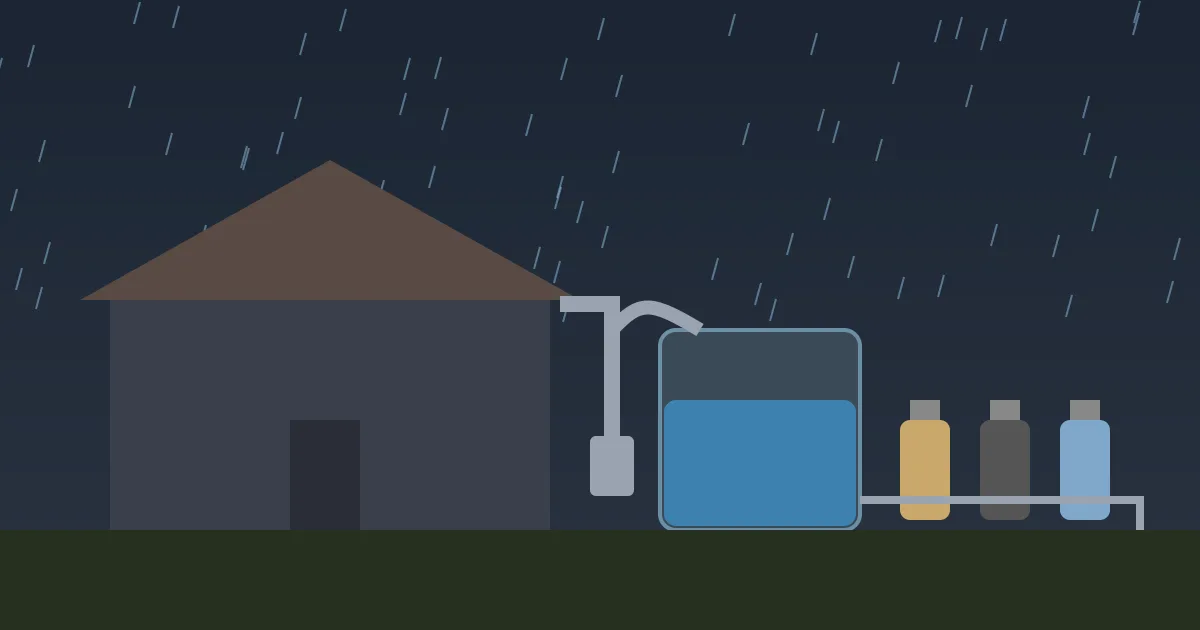
Quick answer: Every inch of rain on every square foot of roof gives about 0.623 gallons, so a 1,000 sq ft roof collects around 500 gallons per inch after losses. Build it in this order: gutter screens → first-flush diverter → opaque food-grade tank with screened inlet and overflow → sediment filter. That’s plenty for the garden. For drinking water you also need activated carbon plus disinfection (UV or boiling), regular maintenance, and water testing. Check your local rules first.
A roof is a big free water catchment that most people pipe straight into the storm drain. Harvesting it cuts water bills, keeps a garden alive through dry spells, and gives you a stored supply for emergencies. It’s also one of the most satisfying weekend projects there is: the next storm fills your tank, and you can see exactly what you built doing its job.
1. Check the rules
Rainwater harvesting is legal in every US state, but some regulate it. Colorado, for example, lets most homeowners use up to two barrels totalling 110 gallons. Several states offer rebates. Rules on using rainwater indoors or for drinking are stricter and often involve plumbing codes. Look up your state and city before buying tanks.
2. Size it
Gallons = roof area (sq ft) × rainfall (inches) × 0.623 × efficiency. Use the footprint of the roof, not the sloped surface area. Efficiency is typically about 0.75–0.9 once you account for splash, evaporation and the first-flush diversion. The calculator below does it for you and suggests a tank size.
<!DOCTYPE html><html><head><meta charset="UTF-8"><title>Rainwater calculator</title><style>
  :root { color-scheme: dark; }
  * { box-sizing: border-box; }
  body { margin: 0; padding: 18px; font: 15px/1.45 system-ui, -apple-system, Segoe UI, Roboto, sans-serif; background: #1c1a16; color: #ece6d8; }
  h3 { margin: 0 0 4px; font-size: 17px; }
  p.sub { margin: 0 0 12px; color: #a39b8a; font-size: 13px; }
  .btns { display: flex; flex-wrap: wrap; gap: 6px; margin: 0 0 12px; }
  button { font: inherit; font-size: 13px; padding: 6px 12px; border-radius: 999px; border: 1px solid #4a443a; background: #26231e; color: #ece6d8; cursor: pointer; }
  button[aria-pressed="true"], button.primary { background: #e06c5a; color: #1c1a16; border-color: #e06c5a; }
  .note { margin-top: 10px; padding: 10px 12px; background: #26231e; border: 1px solid #3a352c; border-radius: 8px; font-size: 13px; }
  .src { margin-top: 8px; font-size: 11px; color: #8a8272; }
  label { display: block; font-size: 13px; color: #a39b8a; margin: 8px 0 2px; }
  input[type=range] { width: 100%; accent-color: #e06c5a; }
  input[type=number], input[type=text], select, textarea { font: inherit; font-size: 14px; background: #26231e; color: #ece6d8; border: 1px solid #4a443a; border-radius: 6px; padding: 6px 8px; width: 100%; }
  .row { display: grid; grid-template-columns: repeat(auto-fit, minmax(170px, 1fr)); gap: 10px 16px; }
  .big { font-size: 28px; font-weight: 700; color: #f2b35b; line-height: 1.1; }
  .muted { color: #a39b8a; font-size: 13px; }
  .ok { color: #7cd992; } .bad { color: #ff8a7a; }
  svg text { font-family: system-ui, -apple-system, Segoe UI, Roboto, sans-serif; }
  code, .mono { font-family: ui-monospace, SFMono-Regular, Menlo, Consolas, monospace; }
</style></head><body>
<h3>Rainwater harvest calculator</h3>
<p class="sub">Roof footprint, not sloped area. Find your average annual rainfall from your local weather service.</p>
<div class="row">
  <div><label>Roof footprint: <b id="av">1500</b> sq ft</label><input id="a" type="range" min="100" max="5000" step="50" value="1500"></div>
  <div><label>Rain in one storm: <b id="sv">1</b> in</label><input id="s" type="range" min="0.1" max="4" step="0.1" value="1"></div>
  <div><label>Annual rainfall: <b id="yv">38</b> in</label><input id="y" type="range" min="5" max="80" value="38"></div>
  <div><label>Efficiency: <b id="ev">80</b>%</label><input id="e" type="range" min="60" max="95" value="80"></div>
</div>
<div class="row" style="margin-top:10px">
  <div><div class="muted">From one storm</div><div class="big" id="storm">—</div><div class="muted" id="barrels"></div></div>
  <div><div class="muted">Per year</div><div class="big" id="year">—</div></div>
  <div><div class="muted">First-flush diverter should hold</div><div class="big" id="ff">—</div></div>
</div>
<svg id="viz" viewBox="0 0 600 150" width="100%" role="img" aria-label="Storm harvest as 55-gallon barrels"></svg>
<div class="note" id="note"></div>
<div class="src">Gallons = area × inches × 0.623 × efficiency. First flush uses 1–2 gal per 100 sq ft (the midpoint, 1.5, is shown). Water weighs about 8.34 lb per gallon.</div>
<script>
function f(n) { return Math.round(n).toLocaleString('en-US'); }
function upd() {
  var a = +document.getElementById('a').value, s = +document.getElementById('s').value, y = +document.getElementById('y').value, e = +document.getElementById('e').value / 100;
  ['a', 's', 'y', 'e'].forEach(function (id) { document.getElementById(id + 'v').textContent = document.getElementById(id).value; });
  var g = a * s * 0.623 * e, yr = a * y * 0.623 * e, ff = a / 100 * 1.5;
  document.getElementById('storm').textContent = f(g) + ' gal';
  document.getElementById('barrels').textContent = '≈ ' + (g / 55).toFixed(1) + ' × 55-gal barrels · ' + f(g * 8.34) + ' lb';
  document.getElementById('year').textContent = f(yr) + ' gal';
  document.getElementById('ff').textContent = f(ff) + ' gal';
  var n = Math.min(40, Math.ceil(g / 55)), full = g / 55, out = '';
  for (var i = 0; i < n; i++) {
    var x = 10 + (i % 20) * 29, yy = 10 + Math.floor(i / 20) * 70, fill = Math.max(0, Math.min(1, full - i));
    out += '<rect x="' + x + '" y="' + yy + '" width="22" height="56" rx="4" fill="#26231e" stroke="#5a7a90"/>';
    out += '<rect x="' + (x + 1) + '" y="' + (yy + 1 + 54 * (1 - fill)) + '" width="20" height="' + (54 * fill) + '" rx="3" fill="#3d8fc4"/>';
  }
  if (Math.ceil(g / 55) > 40) out += '<text x="590" y="146" text-anchor="end" font-size="12" fill="#a39b8a">+' + (Math.ceil(g / 55) - 40) + ' more barrels</text>';
  document.getElementById('viz').innerHTML = out;
  var tank = g * 1.2;
  document.getElementById('note').innerHTML = 'To capture a typical ' + s + '-inch storm without overflowing, a tank of roughly <b>' + f(Math.ceil(tank / 50) * 50) + ' gallons</b> would do. '
    + (g > 110 ? 'That is more than two standard rain barrels. If you live somewhere with a volume limit (Colorado caps most homes at 110 gallons), you\'ll overflow sooner.' : 'A pair of rain barrels would hold it.');
}
['a', 's', 'y', 'e'].forEach(function (id) { document.getElementById(id).oninput = upd; }); upd();
</script>
<script>
(function(){
  var last = 0;
  function report(){
    var h = document.body ? Math.ceil(document.body.getBoundingClientRect().height) : 0;
    if (h && Math.abs(h - last) > 4) { last = h; try { parent.postMessage({ __orchestra: 'preview', kind: 'height', px: h }, '*'); } catch (e) {} }
  }
  window.addEventListener('load', report);
  try { new ResizeObserver(report).observe(document.body); } catch (e) {}
  setTimeout(report, 300);
})();
</script></body></html>
3. Build it, step by step
- Gutter guards and a downspout filter. Keep leaves and twigs out from the start. Every bit of organic debris in the tank becomes food for bacteria.
- First-flush diverter. A vertical pipe section that fills with the first, dirtiest water from each storm, then lets cleaner water flow on to the tank. The rule of thumb is to divert about 1–2 gallons per 100 sq ft of roof, more if you have lots of trees or birds. A small drip valve at the bottom empties it between storms.
- The tank. Use an opaque, food-grade tank or barrel. Light grows algae. Put it on a level, solid base: 55 gallons weighs about 460 lb, and a 1,000-gallon tank over four tons. Screen the inlet and every opening against mosquitoes.
- Overflow. Send it away from the foundation, to a rain garden, a swale or the storm drain, through a screened outlet the same size as the inlet.
- Outlet and tap. Fit the outlet a few inches above the bottom so it draws clear water above the settled sediment. A floating suction intake is even better.
- Filtration, matched to how you’ll use the water (next section).
4. Filtration stages, by use
| Use | What you need |
|---|---|
| Garden, lawn, washing tools | Screens + first flush + a coarse sediment filter so the drip emitters don’t clog |
| Toilet flushing, laundry | Add sediment filtration (e.g. 20 µm then 5 µm) and a pump; check your plumbing code |
| Drinking and cooking | Sediment (20 → 5 µm) → activated carbon (taste, odour, some chemicals) → disinfection with UV (or boiling) → regular lab testing |
Sediment and carbon filters don’t make water safe to drink. Bacteria, viruses and parasites pass straight through them. Disinfection is the step that does that, and UV only works on water that has already been filtered clear.
Maintenance
- Clean the gutters and screens seasonally, and empty the first-flush chamber after big storms.
- Change sediment and carbon cartridges on schedule, sooner if the flow drops.
- Replace UV lamps yearly. They lose strength before they go dark.
- Inspect the tank for sediment and cracks once a year, and test drinking water at least once a year and after any repairs.
Frequently asked questions
How much rainwater can I collect from my roof?
About 0.623 gallons per square foot per inch of rain, roughly 500 gallons per inch from a 1,000 sq ft roof after losses.
Is it legal to collect rainwater?
Yes, in every US state, but some limit it (Colorado: two barrels, 110 gallons total). Check local rules.
Can you drink filtered rainwater?
Only with disinfection (UV or boiling) after sediment and carbon filtration, plus regular testing.
What is a first-flush diverter?
A pipe that catches the dirtiest first runoff so it bypasses the tank. Divert about 1–2 gallons per 100 sq ft of roof.
Comments
Loading the conversation…