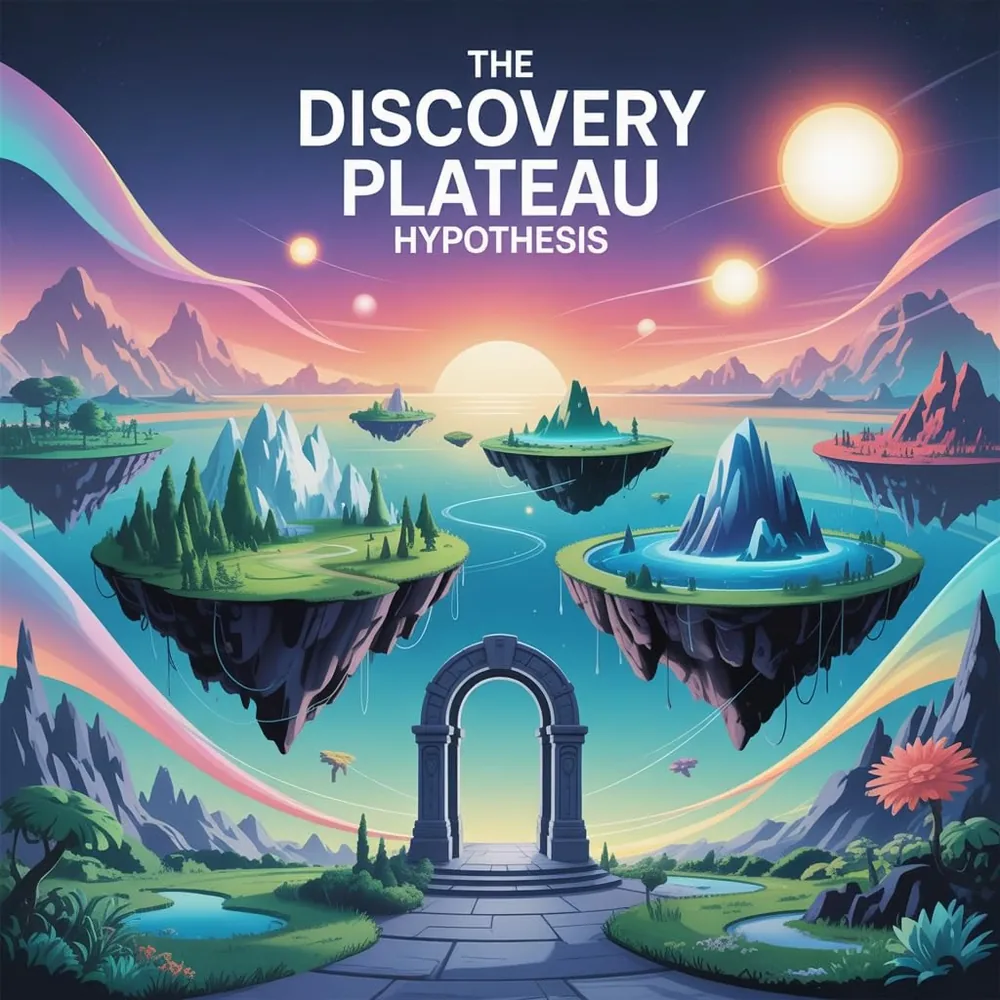
The Discovery Plateau Hypothesis
4 papers 2 books free to read
DPH proposes that fundamental discovery within any bounded system reaches limits dictated by structural and informational constraints — and that the ceiling has consequences worth taking seriously.
The core claim
Start from the Bekenstein bound: a finite region of space can hold only a finite amount of information. Combine it with the observation that paradigms close — that a field, once its framework is settled, yields refinements rather than upheavals. What follows is that discoverable knowledge within any bounded physical system is finite and subject to entropic saturation. Not that discovery stops, but that fundamental discovery approaches an asymptote.
The interesting part is not the ceiling. It is what a civilisation approaching one would rationally do about it.
Where it goes
If discoverable knowledge saturates, then a sufficiently advanced civilisation has a motive to build something that generates novelty beyond its own ceiling — a simulated multiverse operating as a novelty-harvesting engine. That is the line from the foundational paper to the simulation argument, and it is an argument from motive rather than from evidence.
Two later papers push in different directions. One asks whether the boundaries between branches are perfectly sealed, or whether information leaks — described in the paper itself as “speculative but internally disciplined”, which is the right register for it. The other goes the opposite way and tries to settle something concrete: whether an information conservation law can remove the Born rule as the wedge between the Copenhagen and Everett interpretations.
What is settled and what is not
Worth being direct, because frameworks like this are usually presented with more confidence than they have earned. The papers label their own claims, and the labels differ: the information-theoretic groundwork is argued from established bounds; the saturation dynamics are a hypothesis with quantitative models attached; the multiverse and leakage material is explicitly conjectural. The fourth paper is a different kind of thing altogether — a proposal about quantum interpretation that stands or falls on its own.
Read them in the order below and that structure is visible. Read the summaries alone and it is not.
The papers
In reading order, and all four are free on SSRN. This page replaces the separate research index — one list, with the argument around it, rather than two tabs showing the same four titles.
- 1
The Discovery Plateau Hypothesis
A Unified Theory of Knowledge Limits, Multiverse Simulation Reality, and Synthetic Data Harvesting
The foundational paper. Discoverable knowledge within any bounded civilisation approaches asymptotic saturation — and that ceiling has consequences. Also available as a book.
- 2
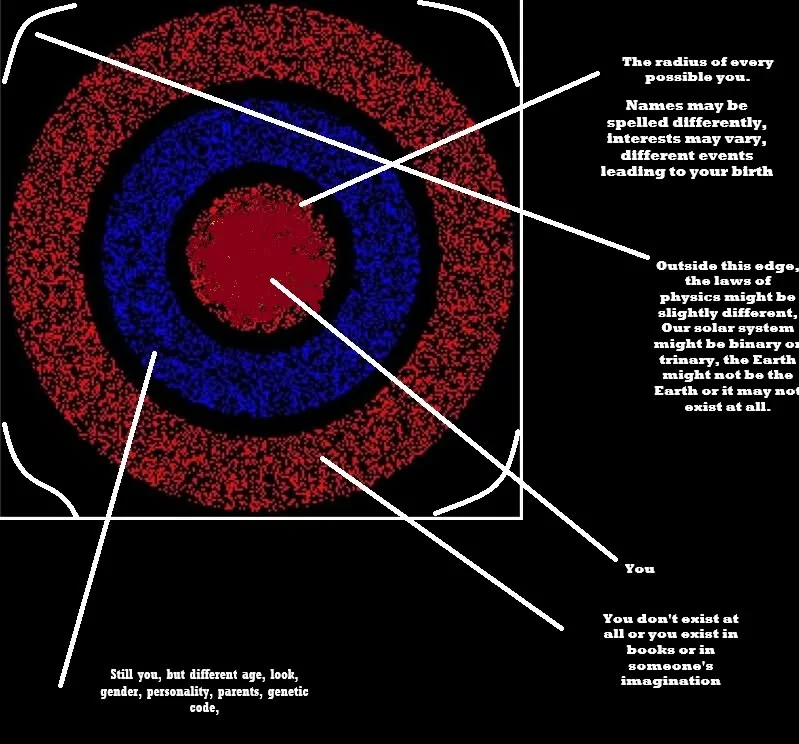
Boundary Permeability in Finite Information Systems
A Formal Extension of the Discovery Plateau Hypothesis Toward a Theory of Interdimensional State-Space Leakage
Extends the Discovery Plateau Hypothesis toward the question of whether branch isolation degrades — and what would follow if it does. The paper is explicit that this is a conjecture rather than a result.
- 3
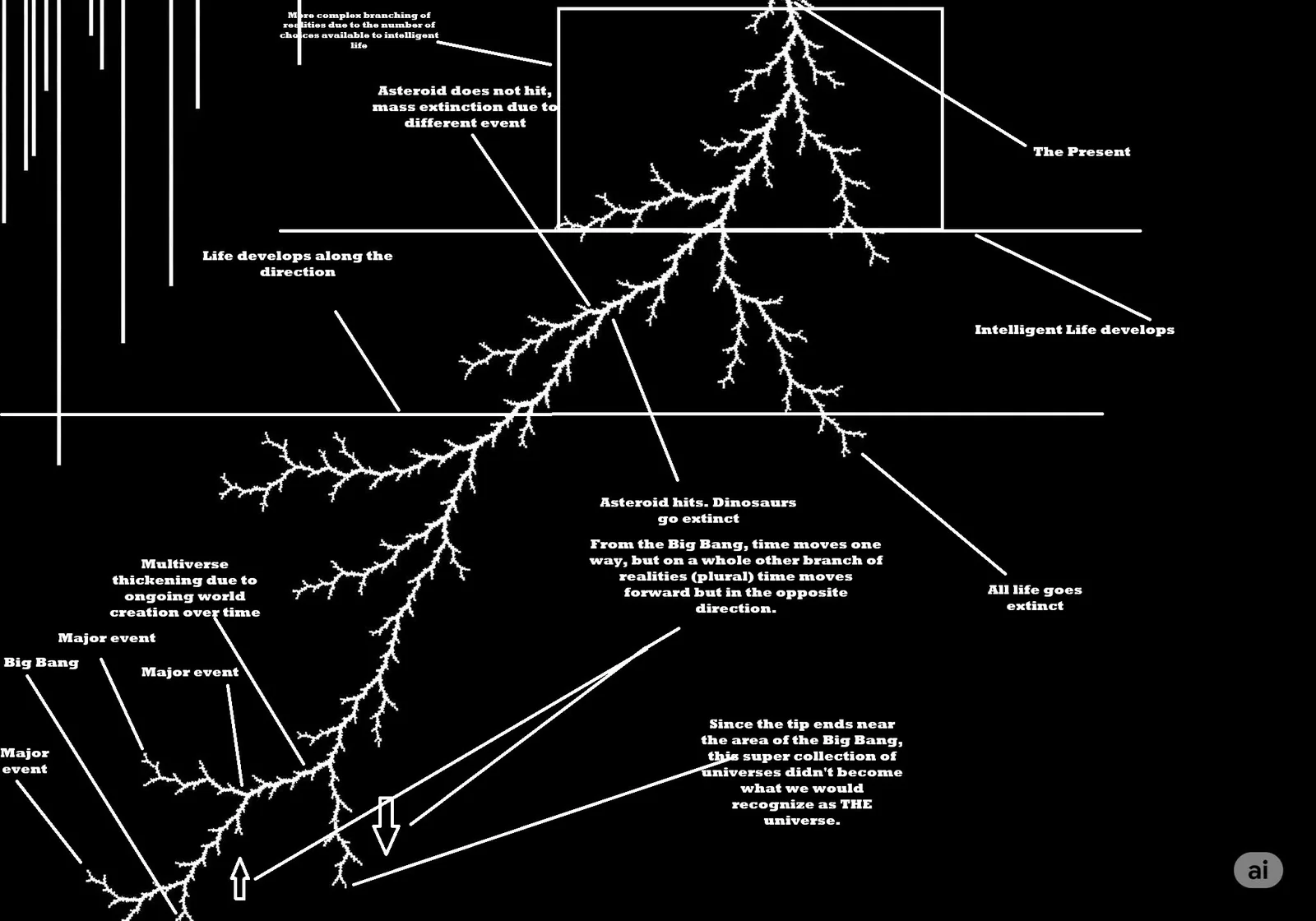
The Copenhagen–Everett Bridge
Information Conservation Principle Unifies Quantum Interpretations
Copenhagen and Everett have been treated as competitors for seven decades, with the Born rule as the wedge between them — an unexplained postulate on one side, a contested derivation on the other. This paper argues the wedge can be removed by a universal conservation law.
- 4

Transistors and Symphonies
Orchestrated Networks of Specialized Small Language Models as a Scalable Alternative to Monolithic LLMs
The argument underneath OMMAIS: that a coordinated panel of small, specialised models is a scalable alternative to one very large one.
Prefer it as a book?
The foundational material is also published as The Discovery Plateau Hypothesis — the same argument, written to be read start to finish rather than cited.
Amazon links here are affiliate links: as an Amazon Associate I earn from qualifying purchases. It costs you nothing extra.
Following the work
New papers appear on the SSRN author page, and I write about the work in progress under the DPH tag. The RSS feed carries everything.