Europa Is the Best Bet for Life Beyond Earth
On this page · 5 sections
- Also see: The K2-18b wars
- Also see: What if the moon disappeared tomorrow
- Also see: Ninety ripples: LIGO’s third catalog
Every few years astronomy produces a discovery that rearranges the search for life, followed by a decade of patient argument about what was actually seen. K2-18b was the latest round: a possible biosignature gas, contested on refit. Europa is the opposite kind of target. Nobody claims to have seen life there. What we have is a world whose potential habitability can be evaluated from physics and chemistry. That is not “better” than a detection; it is a more tractable scientific question.
Habitability is deliberately a lower bar than life. It asks whether liquid water, useful chemistry, and sustained energy could coexist. It cannot tell us whether life ever began there, whether it endured, or whether a biosignature would be distinguishable from geology. Keeping those questions separate is what makes Europa exciting without turning it into a promised alien ocean.
Twice Earth’s oceans, under ice
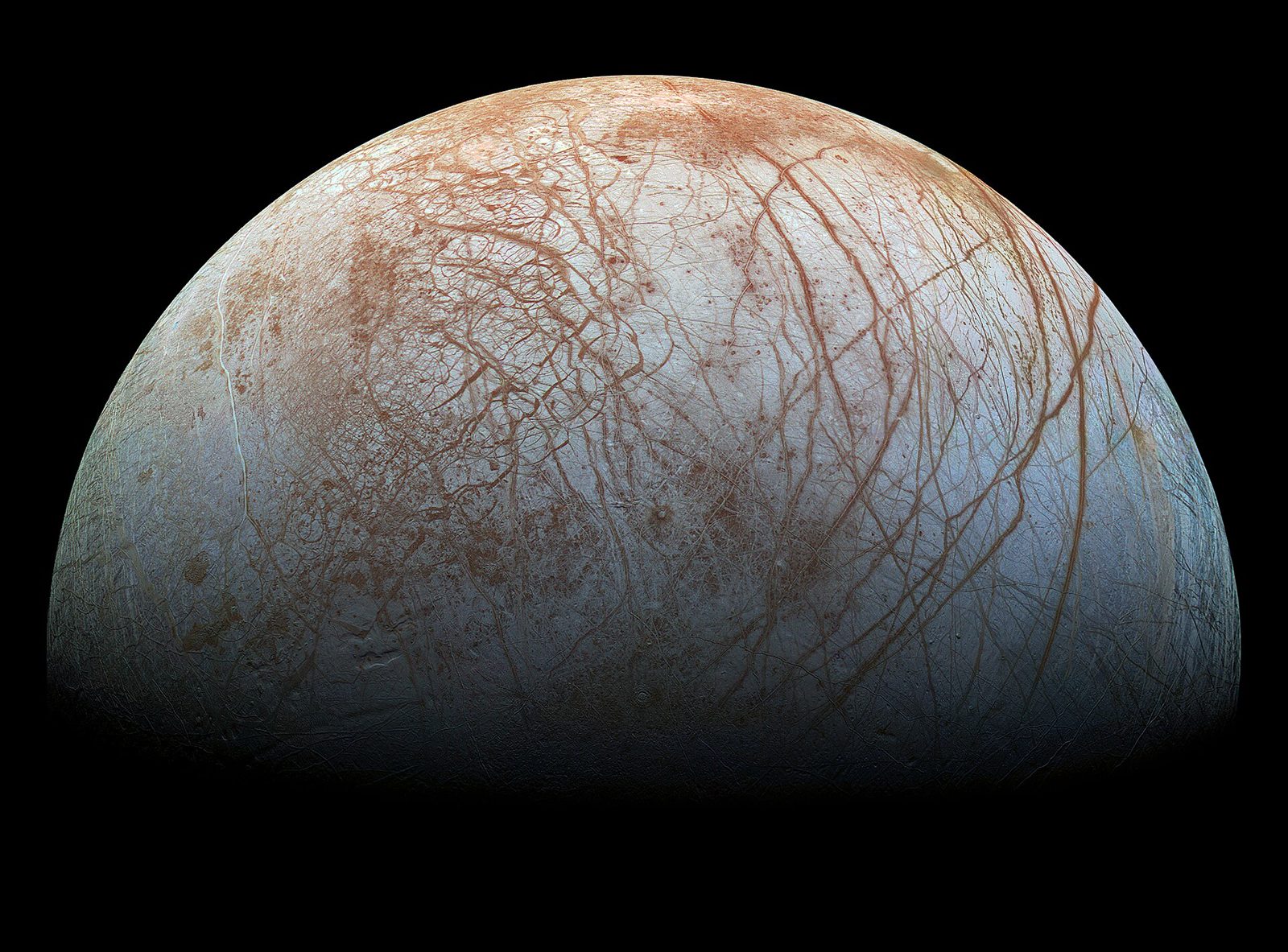
Europa is barely smaller than Earth’s moon, yet scientists estimate that it may hold more than twice the liquid water of all Earth’s oceans combined. Galileo’s magnetometer found an induced magnetic signature in the 1990s that is consistent with a deep, salty, electrically conducting layer. The leading interpretation is a global ocean; the details—its depth, salinity, ice-shell thickness, and exchange with rock—are still measurements to refine rather than settled facts. Those details matter because they determine whether oxidants made at the surface can meet reduced chemicals from the interior.
type: bar
title: Liquid-water volume of the leading ocean targets
x: Earth oceans, Europa, Enceladus, Titan subsurface
Water volume, 10^9 km3: 1.4, 2.8, 0.05, 18
Titan’s number needs its footnote: that vast subsurface ocean may be sealed between ice layers, cut off from the rocky core. Europa’s ocean touches rock. On Earth, water meeting rock is where the interesting chemistry happens - hydrothermal vents, serpentinization, the whole catalogue of energy sources life exploits without sunlight.
The heater that never switches off
An ocean is only habitable while liquid, and Europa is far from the sun. The heat comes from tides. Europa orbits Jupiter in a resonance with Io and Ganymede that keeps its orbit slightly eccentric; Jupiter’s gravity kneads the moon on every pass, and the friction keeps the interior warm. This is not transient warmth. The resonance has held for billions of years, so Europa’s ocean has plausibly been liquid and stable longer than life has existed on Earth.
flowchart TD
    A["Resonance with Io and Ganymede"] --> B["Eccentric orbit maintained"]
    B --> C["Tidal kneading by Jupiter"]
    C --> D["Interior heat, billions of years"]
    D --> E["Liquid ocean touching rock"]
    E --> F["Energy plus water plus chemistry"]
Compare the alternatives and the word “best” becomes a matter of mission design. Enceladus has spectacular advantages: Cassini sampled its plume, finding salts, organics, and evidence of hydrothermal activity. Mars has accessible rocks and a long, readable record of ancient environments. Titan has abundant organic chemistry but is extraordinarily cold. Europa pairs a very large candidate ocean with sustained tidal energy and a surface that may exchange material with depth, but it hides that ocean beneath ice and in Jupiter’s radiation environment. It is arguably the most compelling ocean-world target, not an uncontested winner in every way.
Water is not enough
An ocean can be sterile if its chemistry has settled into equilibrium. Life needs a continuing mismatch to exploit: an electron donor and an electron acceptor that can react, releasing usable energy. Europa has plausible candidates at both ends of the ocean. Radiation at the icy surface can make oxidants, while water-rock reactions at depth may make reduced chemicals such as hydrogen. The open question is the bridge between them. Does the ice shell recycle surface material downward? Does the seafloor host active water-rock reactions? How much chemical energy reaches the ocean, and on what timescale?
None of those steps has been observed directly. That uncertainty is a virtue in the scientific case: it identifies measurements rather than invitations to wishful thinking. A salty ocean with no effective chemical exchange would still be an extraordinary planetary environment, but a weaker analogue for a living ocean. A demonstrated pathway that maintains disequilibrium would make a much stronger case for future life-detection hardware.
What Clipper will actually test
Europa Clipper, launched in October 2024, is scheduled to enter orbit around Jupiter in April 2030; its Europa flyby campaign is planned to begin in early 2031. It will not detect life directly. Its job is to measure the properties that decide whether a habitable environment is plausible: ice-penetrating radar for shell structure, magnetometry and gravity measurements for the ocean, and spectrometers and imaging for surface chemistry and geology. Its 49 close flybys trade continuous exposure for repeated short visits, a trajectory designed to gather global coverage while limiting radiation damage.
And then there are the plumes. Hubble observations have reported hints of intermittent water vapour, but their persistence and source remain uncertain. If a plume is present at the right place and time, Clipper’s instruments could analyse material above the surface; it would be an extraordinary opportunity, not a guaranteed ocean sample. That distinction is the character of the mission: each result narrows a chain of evidence, and the next mission will be designed around what survives that chain.
What would change the case
The strongest result would not be a single intriguing molecule. Astrobiology needs converging evidence: a confirmed ocean, an energy gradient that can persist, salts and organics in a plausible geologic context, and a credible route by which the surface observation represents the ocean below. Conversely, a thick, stagnant ice shell or chemistry isolated from the rocky interior would not make Europa uninteresting; it would revise the kind of environment scientists think it is. That is why a reconnaissance mission is valuable. It turns a beautiful hypothesis into constraints for a future lander or, eventually, a sampling mission.
For mission facts and the current timeline, see NASA’s Europa Clipper overview and JPL’s mission timeline.
Further reading from independent authors


Take a break
A mini crossword and a Sudoku, set for this article. They play offline and nothing leaves your browser.
Mini crossword
Across
Down
Sudoku 0:00
Comments
Loading the conversation…