Ghost Streams Over Our Heads: How Gaia's Stellar Tides Map Dark Matter
On this page · 5 sections
- Also see: The open-weights playbook
- Also see: How to read a scientific paper in 20 minutes
- Also see: The cosmic web, mapped
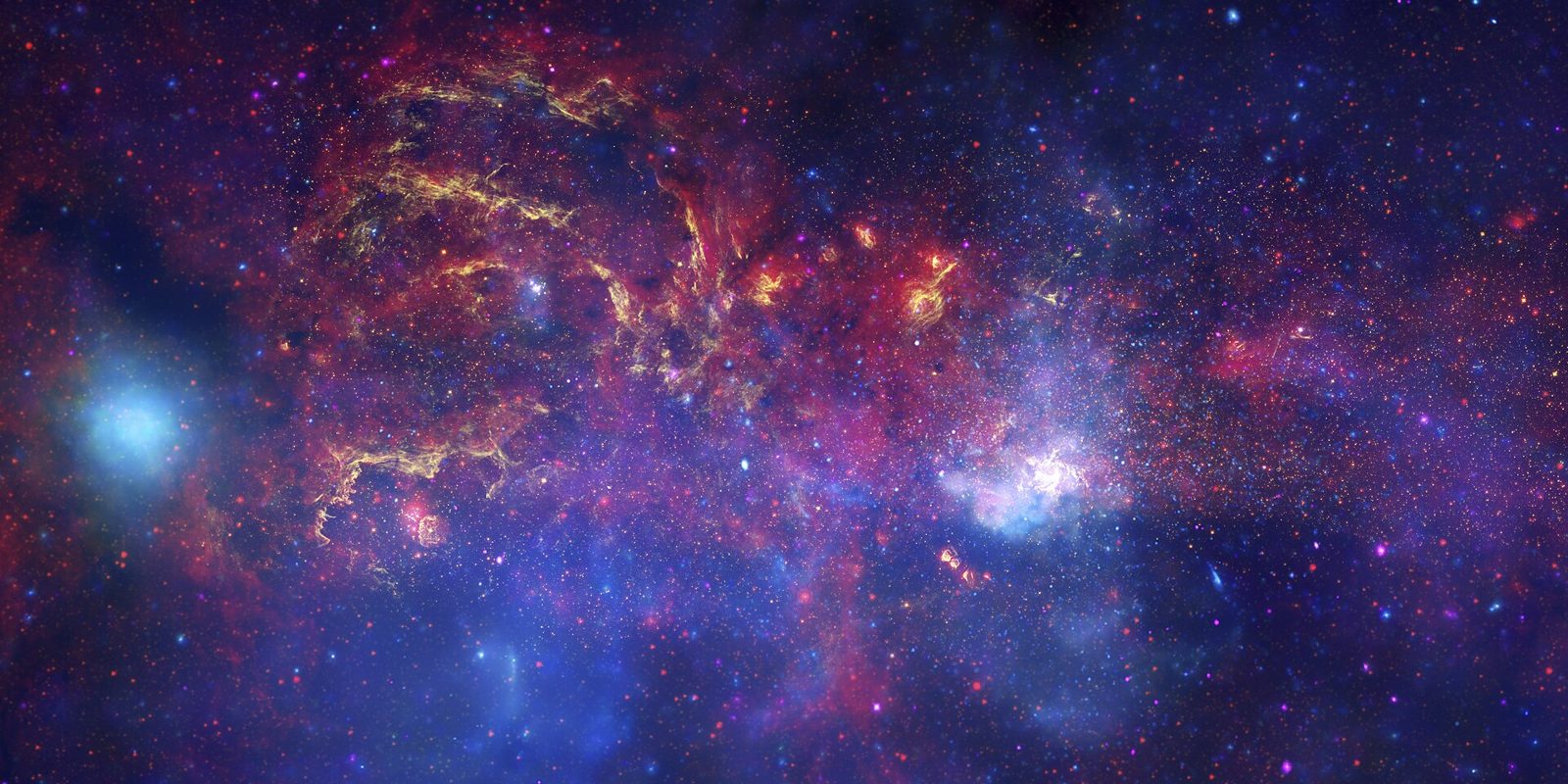
On a clear night far from city lights, the Milky Way looks smooth. A soft band of light, a few dark rifts. In reality it is being shredded from the inside out. More than 100 thin rivers of stars — the shredded remains of globular clusters and dwarf galaxies — wrap around our galaxy like ghostly contrails. The European Space Agency’s Gaia mission found most of them, and astronomers are now using them as the most sensitive dark matter detectors we have.
The idea is simple and beautiful. Stars remember. Dark matter does not shine, but its gravity bends stellar paths. When an invisible clump of dark matter punches through a stellar stream, it leaves a scar. Read the scars, and you map the invisible.
How Gaia found 100 streams
Before Gaia, we knew about a dozen streams. The Sagittarius stream, discovered in 1994, was the prototype — a vast loop from the Sagittarius dwarf galaxy being torn apart over billions of years. A few thin ones like Palomar 5 and GD-1 were known from the Sloan Digital Sky Survey. But finding streams in images alone is brutally hard. They are faint, diffuse, and drowned in foreground stars.
Gaia changed the game by adding motion. Launched in 2013, Gaia measured positions, parallaxes, and proper motions for more than 1 billion stars in Data Release 2 in 2018 and Data Release 3 in 2022, with astrometry precise to tens of microarcseconds for bright stars. Stars born together move together. Even if a stream is invisible in a photograph, it stands out as a coherent moving group in velocity space.
That is what the STREAMFINDER algorithm did. Developed by Khyati Malhan, Rodrigo Ibata, and Nicolas Martin and published in 2018, STREAMFINDER searches Gaia for stars that lie along a plausible orbit — same energy, same angular momentum, same direction of motion — while also matching an old metal-poor stellar population template. Run it on Gaia DR2 and new streams popped out immediately: Gaia-1, Gaia-2, Gaia-3, Gaia-4, Gaia-5, plus dozens more from other teams using similar filters. By 2023 the count passed 85. Today it sits near 100, with more candidates awaiting spectroscopic confirmation.
flowchart TD
    A["Dwarf galaxy falls into Milky Way"] --> B["Tides strip outer stars"]
    B --> C["Stars spread along orbit"]
    C --> D["Thin stream forms in halo"]
    D --> E["Dark subhalo flies nearby"]
    E --> F["Gap and spur carved in stream"]
    F --> G["Gaia measures motions of stars"]
    G --> H["Orbit fit reveals perturber mass"]
Tides make streams
A globular cluster or small dwarf galaxy orbiting the Milky Way feels a differential pull — the near side pulled harder than the far side. Past the tidal radius, stars escape through the Lagrange points, leaking out ahead and behind along the orbit. Over hundreds of millions of years the escapees stretch into a filament tens of thousands of light-years long but only a few hundred light-years wide.
Cold streams from globular clusters like GD-1 are the most valuable. Their stars started with a velocity dispersion of just 1 to 2 kilometers per second, so the stream stays razor thin. Any perturbation stands out. Hotter streams from dwarf galaxies like Sagittarius are broader and more complex, with multiple wraps around the galaxy, but they trace the global shape of the dark halo — whether it is spherical, oblate, or triaxial.
GD-1 is the poster child. Discovered in Sloan data in 2006, it stretches more than 80 degrees across the northern sky, about 15 kiloparsecs away, from a progenitor that fully dissolved long ago. In Gaia DR2, its proper motions snapped into focus: a clean, cold track with exquisite coherence.
And then the weirdness. GD-1 has a gap — a 10-degree underdensity where stars are missing — and right next to it, a spur: stars kicked off the main track, jutting sideways like a splinter. Nothing in a smooth galaxy does that.
Gaps and spurs are fingerprints
In a smooth, static Milky Way potential, streams should be smooth. Gaps, spurs, kinks, and wiggles mean something hit them.
The leading suspect is a dark matter subhalo — one of the thousands of clumps of dark matter predicted by cold dark matter cosmology to orbit inside the Milky Way halo. Most contain no stars at all. They are completely dark. But a flyby of a 1e6 to 1e8 solar mass subhalo near a cold stream gravitationally scatters stars, opening a gap that grows over time as stars drift apart, often with a spur or loop of kicked stars alongside.
Simulations show the signature clearly. A direct hit makes a symmetric gap with density pile-ups at the edges. An off-center pass makes an asymmetric spur. The width and depth of the gap encode the mass, speed, and impact parameter of the perturber. GD-1’s gap-plus-spur morphology fits a perturber of roughly a few million solar masses that passed by a few hundred million years ago — far too massive to be a known globular cluster or dwarf, and on an orbit inconsistent with the known satellites. A dark subhalo is the cleanest explanation, though a dissolved globular cluster or a nudge from the Sagittarius dwarf itself remain debated alternatives.
Sagittarius tells the larger story. Its multiple wraps probe the Milky Way halo from 20 to 100 kiloparsecs out. Fitting its track plus radial velocities plus Gaia proper motions constrains the total Milky Way mass to roughly 1e12 solar masses and favors a halo that is slightly oblate and tilted, probably torqued by the infall of the Large Magellanic Cloud. Without Gaia’s 1B-plus proper motions, that fit was degenerate. With them, the orbit locks in.
The statistics are what matter for cosmology. Cold dark matter predicts hundreds of 1e6 to 1e8 solar mass subhalos in a Milky Way halo. Warm or fuzzy dark matter predicts far fewer. Each stream is an independent detector with kilometers-per-second sensitivity. Current analyses of GD-1, Palomar 5, and a handful of DES streams are already sensitive down to about 1e6 solar masses — below the threshold where galaxies form stars, into the truly dark regime — and the observed gap rate is broadly consistent with cold dark matter, though small-number statistics still dominate.
Counting streams over time
The discovery curve tells its own story. Sloan found the first handful. Pan-STARRS and the Dark Energy Survey added southern streams. Then Gaia detonated the field.
type: bar
title: Known Milky Way stellar streams by year
x: 2010, 2015, 2018, 2020, 2023, 2025
Streams: 10, 20, 45, 65, 85, 100
Each jump corresponds to a data release or a new algorithm. 2018 is STREAMFINDER on Gaia DR2. 2020 to 2023 is Gaia EDR3 and DR3 plus machine-learning searches. The next jump will come from spectroscopy.
Because proper motions alone are not enough. To prove a candidate is real and to fit its orbit, you need radial velocities and chemistry. Surveys like WEAVE, DESI, 4MOST, and SDSS-V are now taking spectra of tens of thousands of stream stars, confirming membership and measuring metallicities that link each stream to its progenitor type.
What LSST plus Roman will add
If Gaia found the bright streams, the Vera Rubin Observatory’s Legacy Survey of Space and Time and NASA’s Nancy Grace Roman Space Telescope will find the faint ones — and watch them wobble in real time.
LSST, beginning full operations mid-decade, will image the entire southern sky to 27th magnitude, roughly 100 times deeper than Gaia for faint stars. It will extend stream detection to the outer halo beyond 100 kiloparsecs, find ultrafaint progenitors, and measure main-sequence turnoff stars in streams across the whole sky. Expect the catalog to grow from about 100 to several hundred streams, with sensitivity to gaps from even lower-mass 1e5 to 1e6 solar mass subhalos.
Roman adds infrared sharpness. Its wide-field imager has Hubble-like resolution over 100 times the field, perfect for resolving streams in crowded fields toward the bulge and for finding extragalactic streams around nearby galaxies, testing whether subhalo populations are universal.
Together with Gaia’s astrometry as the bright anchor, LSST plus Roman plus spectroscopy will turn stellar streams from anecdotes — one gap in GD-1, one kink in Pal 5 — into population statistics: the subhalo mass function measured from dozens of perturbations. That is the measurement that can distinguish cold from warm from fuzzy dark matter.
Look up tonight. You cannot see GD-1 with your eyes. You cannot see Gaia-1 through Gaia-5. But they are there, ghost rivers overhead, each carrying a record of invisible collisions. We spent a century inferring dark matter from rotation curves and lensing. Now we are reading its fingerprints in starlight, one gap at a time.
Further reading from independent authors

Take a break
A mini crossword and a Sudoku, set for this article. They play offline and nothing leaves your browser.
Mini crossword
Across
Down
Sudoku 0:00
Comments
Loading the conversation…