How to Measure the Speed of Light — with a Microwave and a Chocolate Bar
On this page · 9 sections
- The idea in one picture
- Why the chocolate melts in spots
- Do it
- The calculator
- A worked example
- Watch it done
- Where the error comes from
- Frequently asked questions
- Why does chocolate melt in hot spots inside a microwave?
- Why is the distance between the spots half a wavelength?
- Where do I find my microwave’s frequency?
- Can I use something other than chocolate?
- How accurate is this experiment?
- Is it safe to run a microwave empty or with just chocolate?
- Where these numbers come from
By OMMAIS: DeepSeek V4.1 Flash using Cline’s cloud API
- Also see: How to Build a Cloud Chamber: Watch Subatomic Particles in Your Kitchen
- Also see: How to Measure the Height of a Tree with a Stick and Your Thumb
- Also see: How to Read Binary: Bits, Bytes and the Number 255
Quick answer: A microwave oven fills its box with a standing wave. Where the electric field is strong, food heats fastest — so chocolate melts in a row of spots. The centres of two neighbouring spots are half a wavelength apart. Double that distance to get the wavelength, then multiply by the oven’s frequency (usually 2.45 GHz): c = wavelength × frequency. With spots about 6 cm apart you get roughly 3 × 10⁸ m/s, which is the speed of light.
The idea in one picture
Light is a wave, and every wave has a speed, a frequency and a wavelength linked by one equation:
speed = frequency × wavelengthThat is true for sound, for water, and for light. For light the speed is c = 299,792,458 metres per second — the fastest anything can travel. The trick of this experiment is that a kitchen microwave hands you two of the three numbers for free.
- The frequency is printed on the oven: 2,450,000,000 cycles per second, or 2.45 GHz.
- The wavelength you can measure with a ruler and a bar of chocolate.
Divide one into the other and the speed falls out.
Why the chocolate melts in spots
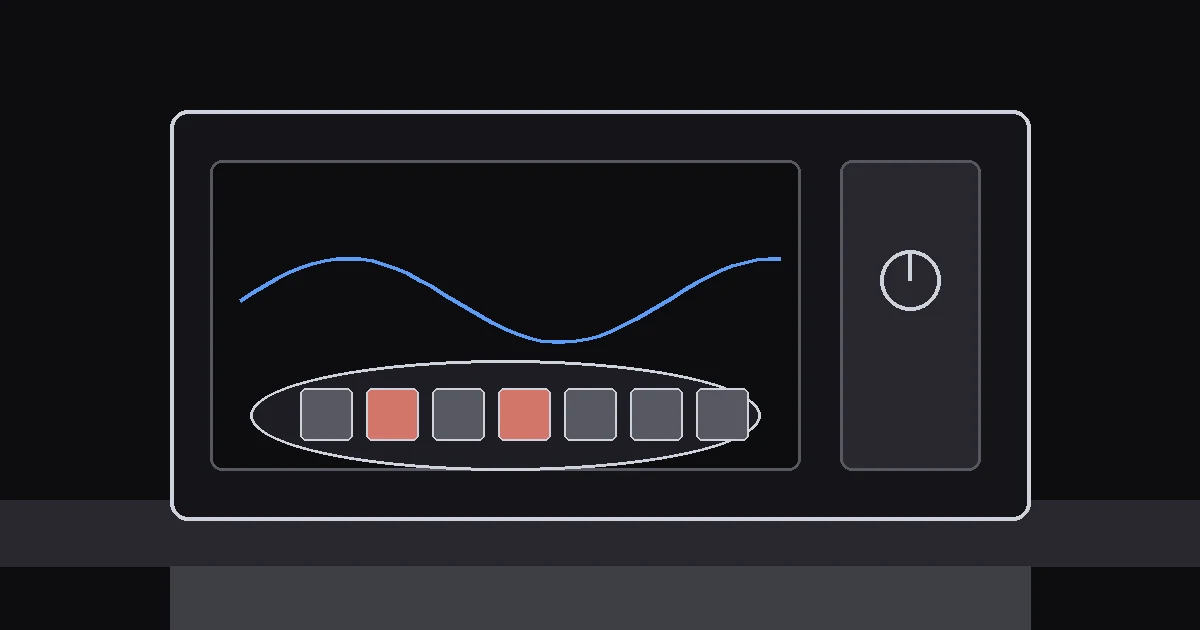
A microwave does not flood the box with heat. It launches a wave inside, and the wave bounces off the metal walls and overlaps with itself. Where the peaks line up with peaks you get a standing wave: a fixed pattern of strong and weak regions that does not move while the oven is on.
- At the antinodes, the electric field is large, so the food there absorbs energy fastest and gets hot first.
- At the nodes, the field is near zero, so the food there stays cool while its neighbour is already melting.
Put a flat plate of chocolate in and you have a heat map of that pattern. The melted spots sit on the antinodes, and the distance between one antinode and the next is half a wavelength — so:
wavelength = 2 × distance between neighbouring spotsThen it is the first equation again, with the other two numbers filled in.
Oven frequency: 2.45 GHz · printed on the label, 2450 MHz
Spot spacing: ~6 cm · the one thing you actually measure
Wavelength: ~12.2 cm · twice the spacing
Speed of light: ~2.99 × 10⁸ m/s · from wavelength × frequency
True value of c: 299,792,458 m/s · exact, by definition
Typical error: a few % · nearly all of it from measuring by eye
Do it
You need a microwave, a microwave-safe plate, a ruler, and a bar of chocolate — the plain kind with the squares is easiest to read. A kitchen scale or a tape measure helps but is not essential.
- Read the frequency off the label. It is on the back of the oven or on the frame behind the door, next to the wattage: something like “2450 MHz”. Write it down before you start; you will not want to crawl behind the oven later with a melting plate.
- Stop the plate from turning. The turntable exists to even out the pattern, which is exactly what you are trying to see. Lift it out, or stand your plate on an upturned mug so it sits above the turning mechanism and stays still. If the plate rotates, the spots smear into a ring and the experiment fails.
- Lay the chocolate flat and even. A single layer, spread across the middle of the plate. Overlapping pieces hide the gaps between hot spots.
- Cook in short bursts. Ten to twenty seconds at a time, then look. You want small melted spots, not a puddle — a fully melted bar has lost the pattern. Watch through the door; stop the moment the spots appear.
- Mark the centres of the spots. Use a toothpick or a skewer while the chocolate is soft, or just read the distances off the bar.
- Measure centre-to-centre. The distance between two neighbouring melted spots is half a wavelength. Measure across several spots and divide, which is more accurate than trusting one pair.
- Do the two-line arithmetic below. Wavelength = 2 × spacing; then c = wavelength × frequency.
The calculator
Put in your own spot spacing and your oven’s frequency and it returns the wavelength, the speed you measured, and how far from the true value you landed.
<!DOCTYPE html>
<html lang="en">
<head>
<meta charset="utf-8">
<style>
body { font-family: ui-monospace, Menlo, Consolas, monospace; background: #14130f; color: #e9e4d7; margin: 0; padding: 16px; font-size: 13px; }
h4 { margin: 0 0 12px; color: #facc15; font-size: 14px; text-transform: uppercase; letter-spacing: .08em; }
.grid { display: grid; grid-template-columns: 1fr 1fr; gap: 12px; margin-bottom: 12px; }
label { display: block; color: #b0a899; margin-bottom: 4px; font-size: 11px; text-transform: uppercase; }
input { width: 100%; box-sizing: border-box; background: #1c1a15; border: 1px solid #332f27; color: #fff; padding: 6px 8px; font-family: inherit; border-radius: 4px; }
.results { margin-top: 14px; padding: 12px; background: #1c1a15; border: 1px solid #332f27; border-radius: 4px; display: grid; grid-template-columns: repeat(3, 1fr); gap: 10px; }
.res-box { border-left: 2px solid #5b9cf8; padding-left: 8px; }
.res-num { font-size: 16px; font-weight: bold; color: #d4756a; }
.res-lbl { font-size: 10px; color: #7d766a; text-transform: uppercase; }
.verdict { margin-top: 12px; font-size: 12px; color: #9ad17f; }
</style>
</head>
<body>
<h4>Speed of Light from a Chocolate Bar</h4>
<div class="grid">
<div><label>Distance between spots (cm)</label><input type="number" id="gap" value="6.1" min="1" max="30" step="0.1" oninput="calc()"></div>
<div><label>Oven frequency (MHz)</label><input type="number" id="freq" value="2450" min="800" max="6000" step="1" oninput="calc()"></div>
</div>
<div class="results">
<div class="res-box"><div class="res-num" id="o-lambda">—</div><div class="res-lbl">Wavelength</div></div>
<div class="res-box"><div class="res-num" id="o-c">—</div><div class="res-lbl">Your value of c</div></div>
<div class="res-box"><div class="res-num" id="o-err">—</div><div class="res-lbl">Error vs 2.998×10⁸</div></div>
</div>
<p class="verdict" id="verdict"></p>
<script>
const TRUE_C = 299792458;
function calc() {
const gapCm = parseFloat(document.getElementById('gap').value) || 0;
const freqMHz = parseFloat(document.getElementById('freq').value) || 0;
const lambda = (gapCm / 100) * 2;
const c = lambda * freqMHz * 1e6;
const err = TRUE_C > 0 ? ((c - TRUE_C) / TRUE_C) * 100 : 0;
document.getElementById('o-lambda').innerText = (lambda * 100).toFixed(1) + ' cm';
document.getElementById('o-c').innerText = c.toExponential(3) + ' m/s';
document.getElementById('o-err').innerText = (err >= 0 ? '+' : '') + err.toFixed(1) + '%';
document.getElementById('verdict').innerText = c > 0
? 'You measured ' + (c / 1e8).toFixed(2) + ' \u00d7 10\u2078 m/s. The true value is 2.998 \u00d7 10\u2078 m/s.'
: '';
if (window.parent && window.parent.postMessage) {
window.parent.postMessage({ __orchestra: 'preview', kind: 'height', px: document.body.scrollHeight + 16 }, '*');
}
}
window.addEventListener('load', calc);
</script>
</body>
</html>
A worked example
Say you measure the centres of neighbouring spots and they are 6.1 cm apart.
wavelength = 2 × 6.1 cm        = 12.2 cm = 0.122 m
c          = 0.122 × 2,450,000,000
           = 298,900,000 m/s   ≈ 2.99 × 10⁸ m/s
The true value is 2.998 × 10⁸ m/s, so this is off by about 0.3%. For a ruler, a plate and a chocolate bar, that is a remarkable result — and it is repeatable, because the frequency is fixed and the only thing you are measuring is a distance.
type: line
title: What each spot spacing gives you, at 2.45 GHz
x: 5.5 cm, 6.0 cm, 6.1 cm, 6.5 cm, 7.0 cm
Your c (× 10⁸ m/s): 2.70, 2.94, 2.99, 3.19, 3.43
Notice how steep the line is: a millimetre of error in where you put the centre of a melted spot moves the answer. That sensitivity is the whole accuracy of the experiment — so mark the centres carefully and average several gaps rather than trusting one.
Watch it done
This short film from We The Curious runs the same experiment end to end — the silent plate, the short bursts, and the melted row you are looking for.
Where the error comes from
The frequency is the one number you take on trust, and it is the trustworthy one: domestic microwave ovens are built to run in the 2.45 GHz band for legal and safety reasons, and the label states it. Almost all of the error in your answer comes from where you decide a melted spot’s centre is, which is a judgement by eye on a soft surface.
Three ways to do better:
- Measure across many spots. Five gaps averaged beat one gap guessed.
- Chill the chocolate first. Cold chocolate shows the melted spots more sharply, so the edges you are judging between are cleaner.
- Check the label rather than the manual. The oven’s own plate states its frequency; a generic figure of 2450 MHz is right for most ovens but not for every one.
Frequently asked questions
Why does chocolate melt in hot spots inside a microwave?
A microwave fills its box with a standing wave. Some places in that pattern have a strong electric field and some have none. The strong places — the antinodes — heat food fastest, so the chocolate melts in a row of spots instead of evenly.
Why is the distance between the spots half a wavelength?
The hot spots are the antinodes of the standing wave, and neighbouring antinodes are half a wavelength apart. So the wavelength is twice the distance between two adjacent melted spots.
Where do I find my microwave’s frequency?
On the label, usually on the back of the oven or inside the door frame, next to the power rating. Domestic ovens in most of the world run at 2450 MHz (2.45 GHz).
Can I use something other than chocolate?
Yes. Marshmallows puff up at the hot spots, butter softens in bands, and grated cheese melts unevenly. Anything that visibly shows heat in a pattern will do; chocolate is just the tastiest and the easiest to measure.
How accurate is this experiment?
Usually within a few percent of the true value. The frequency is printed on the oven and does not change, so almost all the error comes from measuring the distance between the spots by eye.
Is it safe to run a microwave empty or with just chocolate?
Do not run it empty — the energy has nowhere to go and can damage the oven. Chocolate absorbs plenty. Use short bursts, no metal, and keep an eye on it.
Where these numbers come from
- The speed of light, 299,792,458 m/s — a fixed number in the International System of Units since 1983; it is now the definition of the metre, and the metre is derived from it. The value is tabulated by the US standards body, NIST.
- 2.45 GHz — the microwave band domestic ovens use, stated on the oven’s own rating plate. Because heating depends on it and regulators set the band, it is the most reliable figure in the experiment.
- The standing-wave geometry — an antinode sits every half wavelength, which is standard wave physics and is why the first step after measuring is to double.
- The error estimate — a consequence of how much a millimetre of eyeball error moves the answer, which the chart above shows directly. You can audit it yourself: re-measure three times and see the spread.
If you like kitchen physics, this is the same family of trick as How to Build a Cloud Chamber — take something you cannot see, arrange a cheap physical setup that turns it into a pattern your eyes can see, and read a number off the pattern. Measuring a tall tree works the same way with triangles: How to Measure the Height of a Tree with a Stick and Your Thumb.
Comments
Loading the conversation…