Why a monolithic machine cannot do this
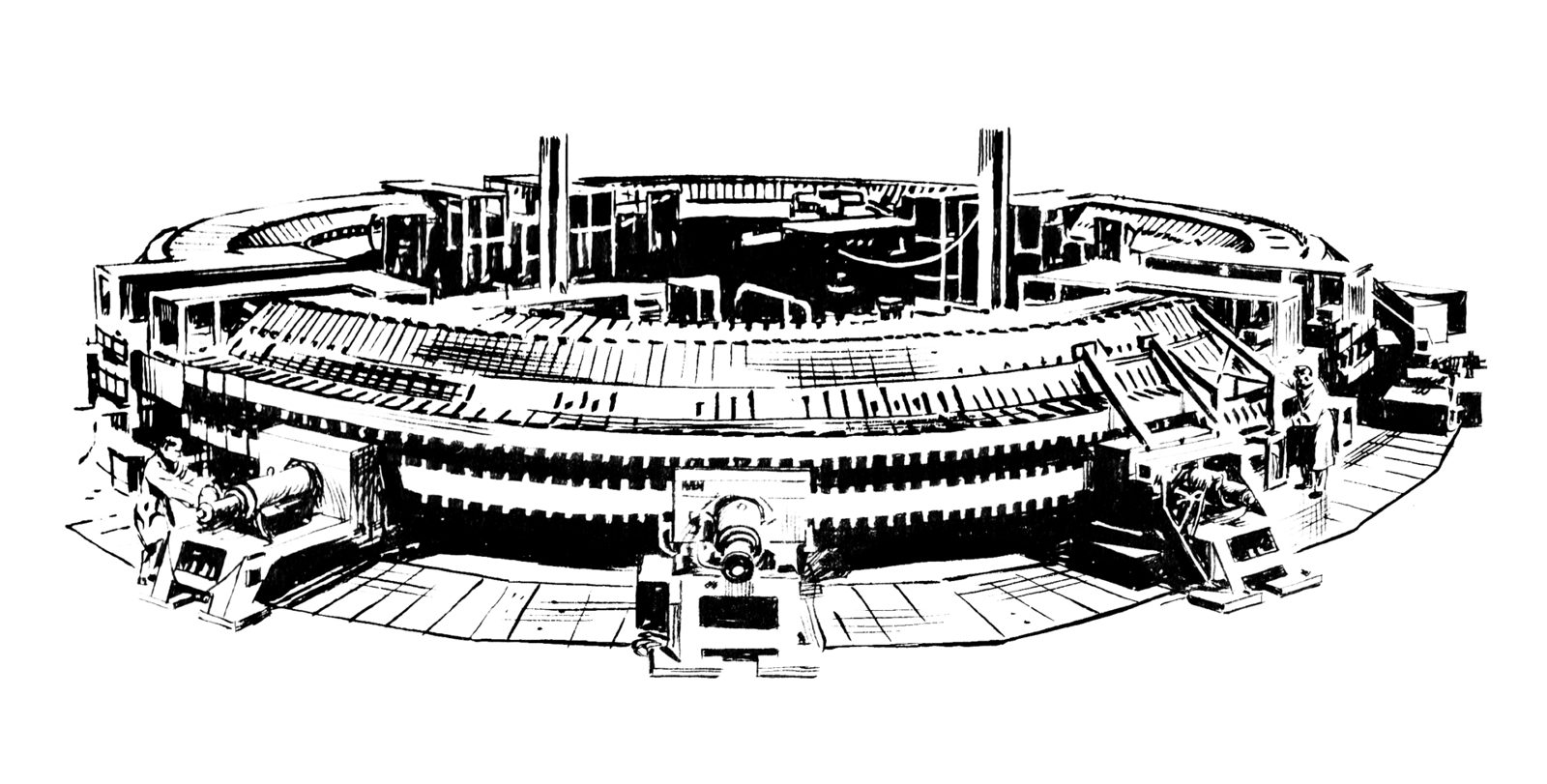
The Forever Machine, if it is ever built, faces a coordination problem no computer has faced: it must monitor a growing population of branches for the appearance of novelty, and it must do so within a computational budget that the horizon bounds. The natural design, one machine watching everything, fails for a reason worth proving. This post is that proof, and it is the reason the framework’s architecture is a federation rather than a brain.
The two costs
Suppose a monolithic supervisor monitors N branches, and to detect novelty it holds and compares full state descriptions: everything each branch has rendered. The cost of the comparison grows as the square of what it compares: N squared, scaled by the per-branch description cost. For a multiverse of any interesting size, N squared against a horizon budget of 10 to the 121 operations is not a shortage, it is a wall: at even a million branches with modest state descriptions, the coordination cost alone exhausts the budget of a Hubble time.
The alternative design: each branch runs its own local observer that compresses its own rendered history into a signature, a fixed-length structured digest of what the branch has discovered, and the supervisor compares signatures. Signature comparison costs N log N: pairwise merging of N digests is the same complexity as sorting, and the digest length is fixed. For the same million branches, the cost is seven orders of magnitude lower. In the paper’s regime, the measured speedup is a factor of 9.17 times 10 to the 13.
Why the speedup is a proof, not an optimisation
It is tempting to read this as an engineering preference, faster is better, but the framework’s claim is stronger: the architecture is forced. The reason is the horizon budget from the operations post. The machine’s total compute is bounded. If coordination cost scales as N squared, then the machine’s branch population is bounded by the square root of the budget, a fixed maximum size after which the supervisor’s bookkeeping consumes everything and rendering gets nothing. A monolithic machine has a maximum size written into the physics. A signature-based federation’s population is bounded by the budget divided by log N, which grows without practical limit. One design hits a wall; the other does not. That is not preference. It is what the bound permits.
There is a second forcing argument from the leakage side. A monolithic supervisor holding full states of all branches is, in the framework’s terms, a single object spanning sectors, and the interface theorems say cross-sector operations are exponentially suppressed. The federation keeps full states local and exchanges only signatures, which are small enough to cross the boundary through the patterned channel the boundary work describes. A brain spanning branches fights the interface; a federation uses it.
What the proof does not settle
The signature design has a price the paper states: signatures lose information, and novelty hiding below the digest’s resolution is missed until a branch’s signature changes enough to trigger a full-state audit. The paper models this as a detection delay and shows the delay is bounded and acceptable for structured novelty, which is the only kind the harvesting theorem values. The proof also assumes signatures are computable in bounded time, which holds for the compressive observers of the resource theory and fails for arbitrary data. Neither caveat rescues the monolith: they bound the federation’s blindness, not its architecture.
The conclusion is the programme’s only architectural claim, and it is derived: if branches are computed and novelty is the product, the machine is a federation of local observers exchanging compressed signatures, and no design that scales better exists inside the horizon’s budget. The next post in this series is the tension the architecture still carries, and it is unresolved on purpose.
The last post in the series is the disagreement it cannot resolve: the hundred-and-twenty-two-order tension.
For the broader case against monolithic AI and why orchestrated architectures matter, see The AI Rogue Panic.