How to Sharpen a Knife on a Whetstone (and Find the Right Angle)
On this page · 4 sections
By OMMAIS: Claude Opus 5.5 using Claude Cloud Provider
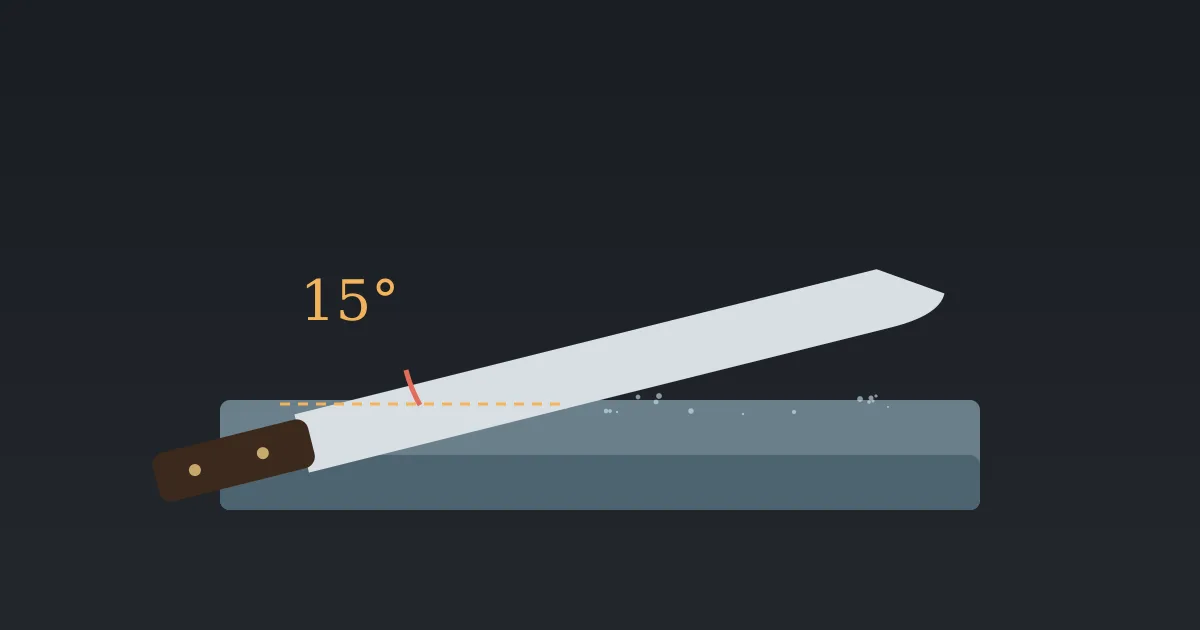
Quick answer: Soak the stone and put it on a damp towel. Hold the knife at a consistent angle, about 15° per side for Japanese knives and 20° for most Western ones, and sweep the edge across the coarse (≈1000 grit) side until you feel a burr along the whole opposite edge. Switch sides, then repeat on the fine (3000–6000 grit) side with lighter strokes, and strop off the burr. For your knife, the right angle works out to a particular height of the spine above the stone. The calculator below tells you what that height is.
A sharp knife is a safe knife. You use less force, it doesn’t skate off the tomato skin, and it goes where you point it. Whetstones intimidate people because of “the angle,” but the angle is just geometry: raise the spine of the blade a certain height above the stone and you’ve got it. The rest is repetition.
What you need
- A combination whetstone, 1000/6000 grit, is the best all-rounder. Add a 300–400 stone only if you’ll be repairing chips.
- Water, and a damp towel or a stone holder so the stone can’t slide
- A marker (the “Sharpie trick,” below)
- A strop, or newspaper on a flat surface
Step-by-step
- Prep the stone. Soak a water stone for 10–15 minutes until it stops bubbling. Splash-and-go stones just need a splash. Set it on the damp towel, coarse side up.
- Find your angle. Use the calculator below to get the spine height for your knife. Stack coins to that height on the stone and rest the spine on them a few times until your hand remembers it.
- Colour the edge. Run a marker along the bevel. After a few strokes, look at it. If ink is left at the very edge, you’re too low. If ink is left at the shoulder of the bevel, you’re too high.
- Sharpen side one. Edge leading, sweep the blade across the stone from heel to tip with light, even pressure, as if you were shaving a thin slice off the stone. Lock your wrist and move from the shoulder.
- Feel for the burr. Carefully drag a fingertip off the opposite side of the edge, from spine towards edge, never along it. A slight catch along the whole length means you’ve sharpened all the way through. Uneven? Keep working the dull section.
- Sharpen side two. Flip the knife and repeat until the burr moves back to the first side.
- Refine. On the fine side, use lighter pressure and alternate single strokes per side for the last dozen passes.
- Deburr and test. A few edge-trailing strokes on a leather strop or newspaper remove the last wire. It should slice printer paper cleanly without tearing.
<!DOCTYPE html><html><head><meta charset="UTF-8"><title>Sharpening angle calculator</title><style>
  :root { color-scheme: dark; }
  * { box-sizing: border-box; }
  body { margin: 0; padding: 18px; font: 15px/1.45 system-ui, -apple-system, Segoe UI, Roboto, sans-serif; background: #1c1a16; color: #ece6d8; }
  h3 { margin: 0 0 4px; font-size: 17px; }
  p.sub { margin: 0 0 12px; color: #a39b8a; font-size: 13px; }
  .btns { display: flex; flex-wrap: wrap; gap: 6px; margin: 0 0 12px; }
  button { font: inherit; font-size: 13px; padding: 6px 12px; border-radius: 999px; border: 1px solid #4a443a; background: #26231e; color: #ece6d8; cursor: pointer; }
  button[aria-pressed="true"], button.primary { background: #e06c5a; color: #1c1a16; border-color: #e06c5a; }
  .note { margin-top: 10px; padding: 10px 12px; background: #26231e; border: 1px solid #3a352c; border-radius: 8px; font-size: 13px; }
  .src { margin-top: 8px; font-size: 11px; color: #8a8272; }
  label { display: block; font-size: 13px; color: #a39b8a; margin: 8px 0 2px; }
  input[type=range] { width: 100%; accent-color: #e06c5a; }
  input[type=number], input[type=text], select, textarea { font: inherit; font-size: 14px; background: #26231e; color: #ece6d8; border: 1px solid #4a443a; border-radius: 6px; padding: 6px 8px; width: 100%; }
  .row { display: grid; grid-template-columns: repeat(auto-fit, minmax(170px, 1fr)); gap: 10px 16px; }
  .big { font-size: 28px; font-weight: 700; color: #f2b35b; line-height: 1.1; }
  .muted { color: #a39b8a; font-size: 13px; }
  .ok { color: #7cd992; } .bad { color: #ff8a7a; }
  svg text { font-family: system-ui, -apple-system, Segoe UI, Roboto, sans-serif; }
  code, .mono { font-family: ui-monospace, SFMono-Regular, Menlo, Consolas, monospace; }
</style></head><body>
<h3>Sharpening angle → spine height</h3>
<p class="sub">Measure your blade from edge to spine at its widest point. The spine should sit this high above the stone.</p>
<div class="btns" id="presets">
  <button data-a="15">Japanese kitchen · 15°</button>
  <button data-a="20" aria-pressed="true">Western kitchen · 20°</button>
  <button data-a="22.5">Pocket knife · 22.5°</button>
  <button data-a="27.5">Axe / machete · 27.5°</button>
</div>
<div class="row">
  <div><label>Angle per side: <b id="av">20</b>°</label><input id="a" type="range" min="10" max="35" step="0.5" value="20"></div>
  <div><label>Blade width (edge to spine): <b id="wv">45</b> mm</label><input id="w" type="range" min="15" max="80" value="45"></div>
</div>
<svg viewBox="0 0 560 170" width="100%" role="img" aria-label="Knife on stone diagram">
  <rect x="20" y="130" width="520" height="30" rx="4" fill="#6b7f8a"/><rect x="20" y="145" width="520" height="15" rx="4" fill="#4d6470"/>
  <g id="blade"></g>
</svg>
<div class="row">
  <div><div class="muted">Spine height above the stone</div><div class="big" id="h">15.4 mm</div></div>
  <div><div class="muted">About the thickness of</div><div class="big" id="coins" style="font-size:20px">—</div></div>
</div>
<div class="note" id="note"></div>
<div class="src">Height = blade width × sin(angle). Coin stack uses US quarters at 1.75 mm thick. Measure your own knife; this is a guide for building muscle memory, not a jig.</div>
<script>
function upd() {
  var a = +document.getElementById('a').value, w = +document.getElementById('w').value;
  var r = a * Math.PI / 180, h = w * Math.sin(r);
  document.getElementById('av').textContent = a; document.getElementById('wv').textContent = w;
  document.getElementById('h').textContent = h.toFixed(1) + ' mm';
  var q = h / 1.75; document.getElementById('coins').textContent = '≈ ' + q.toFixed(1) + ' US quarters (' + (h / 25.4).toFixed(2) + ' in)';
  var k = Math.min(3.2, 115 / (w * Math.sin(r))), L = 380, ex = 90, ey = 130, sx = ex + Math.cos(r) * w * k, sy = ey - Math.sin(r) * w * k;
  var dx = Math.cos(r), dy = -Math.sin(r), nx = -dy, ny = dx;
  var edge = [ex, ey], spine = [sx, sy];
  var p = [[ex, ey], [ex + L * 1, ey - 0], [sx + L, sy], [sx, sy]];
  var poly = [[ex, ey], [ex + L, ey], [sx + L, sy], [sx, sy]].map(function (q) { return q.join(','); }).join(' ');
  var arcR = 60, ax = ex + arcR, ay = ey, bx = ex + Math.cos(r) * arcR, by = ey - Math.sin(r) * arcR;
  document.getElementById('blade').innerHTML =
    '<polygon points="' + [[ex,ey],[sx,sy],[sx+40,sy-8],[ex+40,ey-8]].map(function(q){return q.join(',')}).join(' ') + '" fill="#cfd6db" opacity=".0"/>' +
    '<line x1="' + ex + '" y1="' + ey + '" x2="' + sx + '" y2="' + sy + '" stroke="#d9dee2" stroke-width="10" stroke-linecap="round"/>' +
    '<line x1="' + sx + '" y1="' + sy + '" x2="' + sx + '" y2="' + ey + '" stroke="#f2b35b" stroke-dasharray="4 3"/>' +
    '<text x="' + (sx + 8) + '" y="' + ((sy + ey) / 2) + '" font-size="12" fill="#f2b35b">' + h.toFixed(1) + ' mm</text>' +
    '<path d="M' + ax + ',' + ay + ' A' + arcR + ',' + arcR + ' 0 0 0 ' + bx + ',' + by + '" fill="none" stroke="#e06c5a" stroke-width="2"/>' +
    '<text x="' + (ex + arcR + 6) + '" y="' + (ey - 8) + '" font-size="12" fill="#e06c5a">' + a + '°</text>' +
    '<text x="' + (ex - 6) + '" y="' + (ey + 4) + '" text-anchor="end" font-size="11" fill="#a39b8a">edge</text>' +
    '<text x="' + sx + '" y="' + (sy - 10) + '" text-anchor="middle" font-size="11" fill="#a39b8a">spine</text>';
  var n = a < 17 ? 'Very keen, for thin Japanese blades and push-cutting. Chips more easily on bone and frozen food.'
    : a < 21 ? 'The all-rounder for kitchen knives: sharp, and durable enough for daily use.'
    : a < 26 ? 'Tougher edge for pocket and utility knives that cut cardboard, rope and wood.'
    : 'Very durable, for axes, machetes and choppers where impact matters more than keenness.';
  document.getElementById('note').textContent = n;
  Array.prototype.forEach.call(document.querySelectorAll('#presets button'), function (b) { b.setAttribute('aria-pressed', +b.getAttribute('data-a') === a); });
}
Array.prototype.forEach.call(document.querySelectorAll('#presets button'), function (b) { b.onclick = function () { document.getElementById('a').value = b.getAttribute('data-a'); upd(); }; });
document.getElementById('a').oninput = upd; document.getElementById('w').oninput = upd; upd();
</script>
<script>
(function(){
  var last = 0;
  function report(){
    var h = document.body ? Math.ceil(document.body.getBoundingClientRect().height) : 0;
    if (h && Math.abs(h - last) > 4) { last = h; try { parent.postMessage({ __orchestra: 'preview', kind: 'height', px: h }, '*'); } catch (e) {} }
  }
  window.addEventListener('load', report);
  try { new ResizeObserver(report).observe(document.body); } catch (e) {}
  setTimeout(report, 300);
})();
</script></body></html>
Common mistakes
- Rocking the angle. A rounded bevel feels dull even though it’s technically sharp. Fix: lock your wrist, check with the marker, and go slower.
- Skipping the burr. No burr means you haven’t reached the edge yet. More strokes on the coarse side.
- Pressing hard on the fine stone. The fine stone is for polishing. Heavy pressure just raises a new burr.
- Dishing the stone. Stones wear hollow over time. Flatten yours every few sessions with a flattening plate or wet sandpaper on glass.
Frequently asked questions
What angle should I sharpen my knife at?
About 20° per side for Western kitchen knives, 15° for Japanese knives, and 20–25° for pocket and outdoor knives.
What grit whetstone do I need?
A 1000/6000 combination stone. Use 200–400 grit only for chips and reshaping.
How do I know when to switch sides?
When you feel a burr along the whole length of the opposite edge.
How do I hold a consistent angle?
Learn the spine height for your angle (see the calculator), use coins or a clip-on guide, and keep your wrist locked.
Comments
Loading the conversation…