Paper 15: holographic noise as a spectral shape
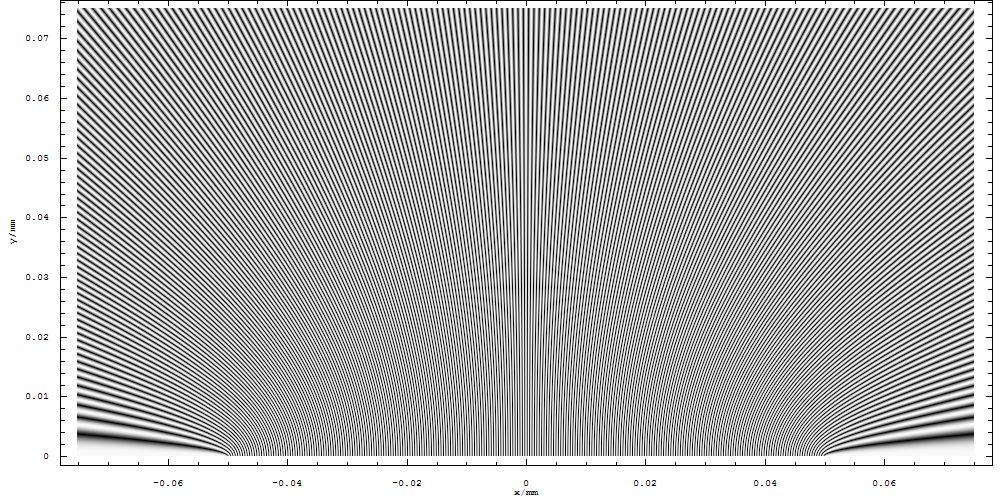
Paper 15 is the framework’s most indirect paper, and possibly its most testable. The reasoning: if the substrate that renders our branch has any discreteness, any finite information density, then that discreteness is not invisible. It shakes spacetime itself, and the shake has a spectrum, and spectra can be measured. This post explains the chain from assumption to interferometer.
Where the noise comes from
Start with the holographic principle: the information in a region is proportional to its boundary area, not its volume, at one fourth of a bit per Planck area. Nobody knows what that means microscopically, but every interpretation shares one feature: position is not perfectly sharp. If a region’s contents are encoded on its boundary, then position in the interior is reconstructed from boundary data, and reconstruction has error. The error is tiny, Planck-scaled, but it is not zero, and it is not static: like any quantum variable, the reconstructed position fluctuates.
Those fluctuations are holographic noise. They are not particles, not fields, not anything crossing the interferometer. They are the uncertainty in where spacetime’s own points are, and two beams in an interferometer sample the fluctuation along two different paths, so the fluctuation shows up as a phase difference with a specific statistical structure. The scale: over the length of a kilometre-class interferometer, the correlated fluctuation is about a Planck length times the square root of the arm length over the Planck length, which lands near 10 to the minus 19 metres, ten orders below atomic but not conceptually unreachable, because interferometers measure phases, and phase sensitivity has improved by twelve orders of magnitude in fifty years.
The spectral shape is the test
The scale alone is old news; several proposals have predicted holographic noise scales, and instruments have placed limits. What the framework adds is a shape claim. Because the substrate’s structure is the topological category, not a generic holographic screen, the noise’s frequency spectrum is not universal. The paper derives the candidate form: the fluctuations inherit the topological theory’s algebra, and the resulting spectrum has a specific angular dependence and a turnover set by the boundary scale, distinguishing it from the flat spectra of generic holographic models and from the instrumental lines of seismic and thermal noise.
That is the falsifiable content, and it is well-posed. Existing interferometric bounds, from the Fermilab Holometer and from gravitational-wave detectors’ noise floors, already constrain part of the parameter space. The framework’s shape, if real, sits partly in the constrained region and partly just outside it, which is the honest position for a shape claim: partly dead, partly reachable, with the surviving region requiring the next generation of correlated interferometers.
What this paper is doing in the series
Position in the series matters. Papers 10, 13 and 14 test the framework through its structure, its spectral feature, its transmission algebra, its error correlations. Paper 15 tests it through its substrate, and the two are logically independent: a null in the noise channel does not touch the leakage hypothesis, and a detection would not confirm the leakage mechanism. What both share is the underlying bet, that the substrate is physical and therefore detectable.
The paper’s honest summary: discreteness is not optional in this framework, discreteness implies position noise, position noise has a spectrum, the spectrum is partly constrained already, and the unconstrained part is narrowing. If the substrate exists with the framework’s structure, an instrument will eventually see this. If it does not, the silence is itself a measurement of how far from reality the framework’s assumptions are. Either way, the numbers are getting better, and the paper says precisely which numbers to watch.
The next paper stops advancing and does something rarer, situating the programme against its neighbours: Paper 16, competing avenues.