Paper 10: a feature in the primordial spectrum
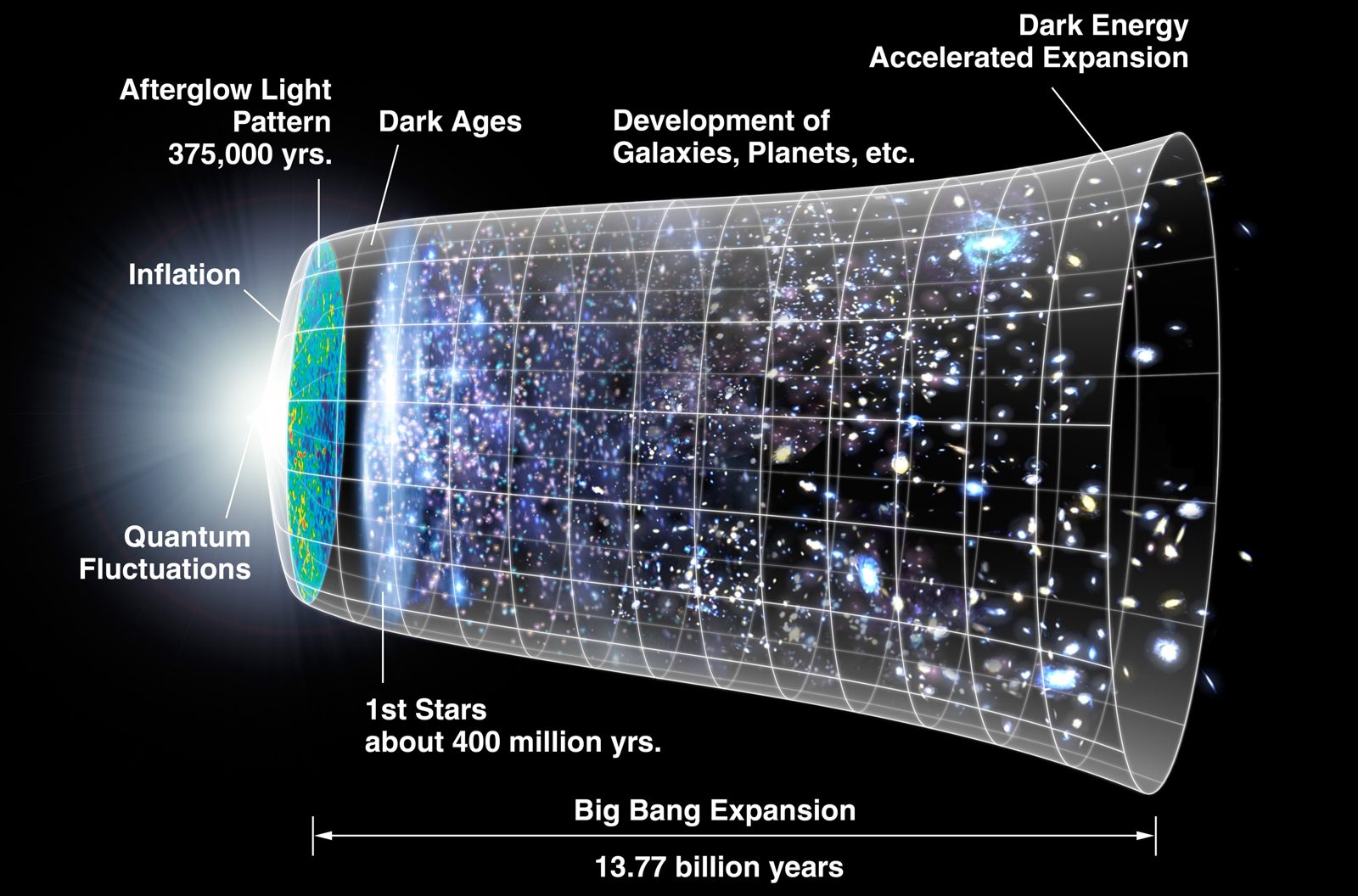
Paper 10 is the framework’s wager on the cosmic microwave background: if branches exist and interact, their interference should leave a feature in the primordial power spectrum, a wiggle in the curve that pure inflation does not predict. It is the paper most likely to be famous or forgotten, and its post is where the phrase testable but not yet tested needs its most careful spelling.
The prediction
The mechanism: primordial fluctuations are generated across a branch ensemble, and the ensemble’s temperature contributions add with a phase. The sum produces an oscillatory modulation of the power spectrum, P of k equals P0 times one plus A times sine of k over k star plus phi. Three parameters: amplitude, frequency scale, and phase. The framework’s derivation of the amplitude gives something near a part per thousand, and the frequency scale comes from the branch structure. The phase is where the paper’s history is most instructive.
The original draft presented the phase as fixed by modular data, pi over 6, giving a clean predicted value. The audit’s finding was that the channel and prefactor producing pi over 6 were chosen after the answer was known: the modular data admits many phases, and the one landing on pi over 6 was selected by looking at the CMB fit. That is the definition of post-hoc, and the paper now says so in its own banner. A phase picked after the fit is a fit, whatever else it is wrapped in.
The companion that makes it honest
The fix was structural: a companion document, Paper 10b, that converts the prediction into a preregistered race. The phase must be predicted before chains are run, from one of two stated routes, modular data with the channel fixed by an independent argument, or a holonomy integral with the cycle fixed by topology. Fitting the phase freely and calling the result a prediction is forbidden by the document’s own rules. The pipeline must be shared with Lambda-CDM, the same data, the same priors, and the decision rule is penalised: the model needs a Bayesian information criterion improvement of more than six, which is the standard for strong evidence, with extra parameters charged.
The companion also hardened the tooling honestly. The cosmological-code scaffold in the repository has known defects, non-existent fields referenced in patches, unverified interfaces, and the document requires Lambda-CDM recovery to a tenth of a per cent before any feature hunt, positivity-preserving parametrisation, fixed seeds, versioned data. None of that is glamour. All of it is the difference between a feature claim and a bug report.
What this is and is not
What it is: a specific spectral shape, three parameters, a phase route that must be stated in advance, and a decision rule that can output a loss. What it is not: a detection, an explanation of existing anomalies, or evidence. The existing low-l anomalies in the CMB are tempting to point at, and the framework deliberately does not, because anomalies known before a prediction was made cannot confirm it.
The wager is live. If the phase route survives, the prediction is parameter-light and falsifiable by data already in hand. If it does not, the paper joins the archive with the others, and the phase post-hoc entry in the corrections series becomes one entry longer. Either outcome is publishable in this archive, which is the whole point of writing the rules before the chains run.
The next paper is the first of Paper 10’s archived companions, and it died of a number invented from nothing: Paper 10a.